Review · SPLIT TOURS
Small-Group Communist Tour of Split – Boutique group tour
Split’s communist past is easiest to grasp beyond the Old Town, where stadiums, shopping centers and planned neighborhoods tell stories that stone palaces cannot. This three-and-a-half-hour tour links those scattered sites by private vehicle, with a local historian and history teacher explaining how Yugoslavia shaped daily life and why it broke apart.
I like two things in particular: the focus on socialist architecture and ordinary life, not just political dates, and the small group size, which allows room for questions. The guide identified for the tour is Boris, and a group this small may even turn into a one-on-one outing if you happen to book alone.
The trade-off is that this is a specialized history tour, not a broad introduction to Split. If your main goal is the Roman palace, waterfront and Old Town, you’ll want to see those separately. The price is also a real consideration for a three-and-a-half-hour outing.
- Poljud Stadium and the China Wall show two very different sides of Yugoslav-era building.
- Koteks shopping center puts socialist consumer life in focus, including the push and pull between East and West.
- Split 3 makes urban planning tangible through its buildings, public spaces and housing story.
- A private, air-conditioned vehicle connects far-flung stops without making you navigate across town alone.
- An armored train at Kopilica station gives the tour a stark final chapter on Yugoslavia’s violent end.
A different route through Split’s past
This tour is for anyone who wants to understand the city beyond its Roman core. It follows the marks left by Yugoslavia’s communist period, from public architecture to shopping and housing, then closes with the conflict that ended the state in the 1990s.
That broad arc matters. Rather than treating communism as an abstract political label, the tour connects it to buildings people used, neighborhoods where they lived and the everyday problem of finding goods in a country positioned between the West and the East. You get a local view of a history that can be difficult to piece together from a short stay in Split.
The tour lasts about three and a half hours and starts at 9:00 am at the bus stop on Trg Franje Tuđmana. A private, air-conditioned vehicle helps make the route practical: the stops are spread across the city, and you don’t have to work out the connections on your own. The group is limited to eight people, which suits a topic that benefits from questions and discussion.
Starting with wartime Split at Trg Franje Tuđmana
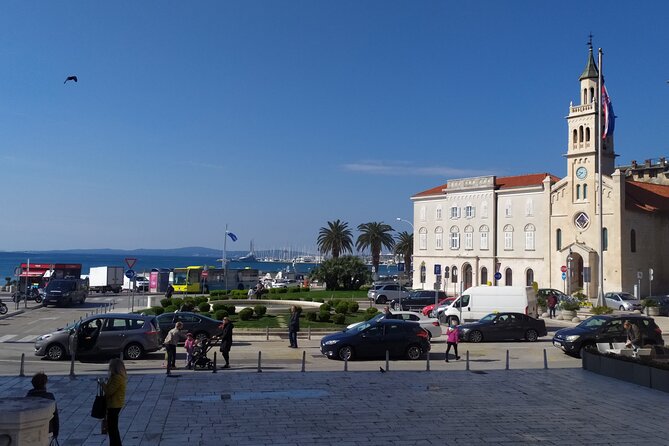
The first 25 minutes set the scene. At Trg Franje Tuđmana, your guide introduces the tour and outlines events in Split and Yugoslavia during World War II that led to the formation of the new communist state. You’ll also see photographs showing wartime damage in Split.
This opening is useful because it gives the buildings and political history a starting point. The tour isn’t simply a parade of concrete structures; it asks what came before the state that built them. If you’re mainly eager to get straight to the architecture, this stop may feel like a slow start, but the context helps the later stops make sense.
It’s worth arriving ready to listen. The early discussion provides the background for the tour’s later account of socialist life, Tito’s rule and the country’s eventual collapse. Since the experience is offered in English, you can follow the explanations without relying on signs or a translated handout.
More tours in Split:
- Split: Krka Waterfalls Trip with Boat Cruise and Swimming
★ 4.8 · 10,519 reviews - From Split: Krka Waterfalls, Food & Wine Tasting Tour
★ 5.0 · 9,326 reviews - Blue cave, Mamma Mia and Hvar, 5 islands speedboat tour
★ 5.0 · 7,150 reviews
Poljud Stadium and the China Wall
A short panoramic stop introduces two striking examples of Yugoslav-era construction. Poljud Stadium was built for the Mediterranean Games, then the biggest sporting event hosted in Yugoslavia. Its design also earned a place in an exhibition of Yugoslav architecture at New York’s Museum of Modern Art, a useful reminder that these buildings were part of an international architectural story, not just local infrastructure.
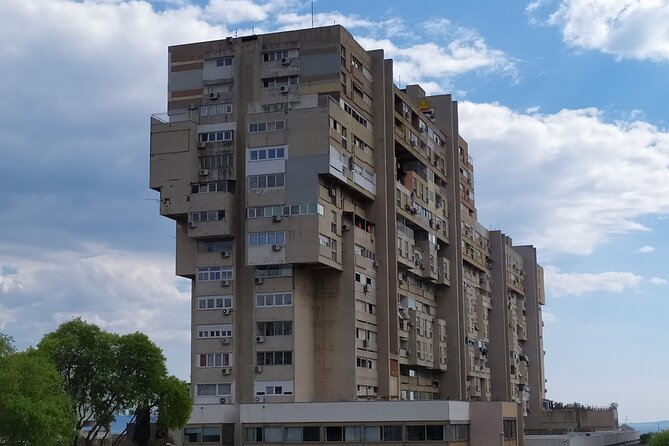
The stadium is presented as a Split symbol, but the stop also looks toward the city’s widest building, known as the China Wall. Its socialist-era design makes a sharp contrast with Poljud’s sporting purpose. Together, the two sites show how ambitious public projects and large-scale housing could both leave a strong mark on a city.
You spend about 10 minutes here, so think of it as a compact viewing and explanation rather than an extended visit. There is no admission charge listed for the stop. If you want a long look at the stadium or a full architectural tour, this isn’t designed to provide either; the value is in seeing the structures as part of a bigger story.
Koteks and the socialist shopping experiment
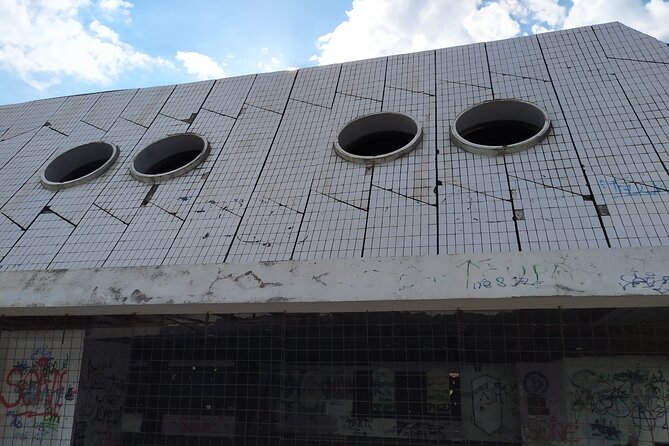
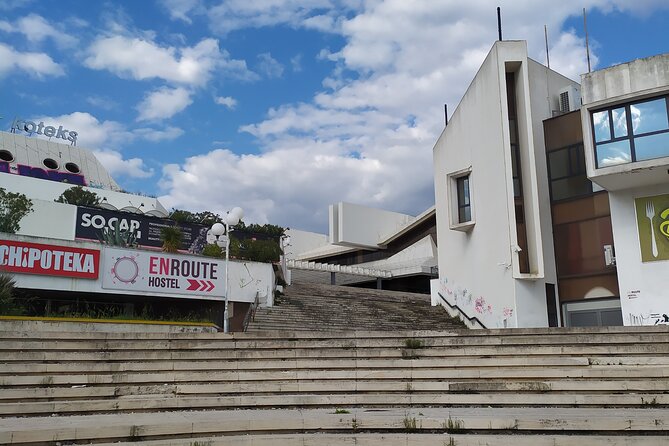
At Prodajni centar Koteks, the group spends around 30 minutes walking around what is described as Yugoslavia’s first shopping mall. The guide explains how shopping was imagined in a communist state, what made the center popular for a time and how its fortunes changed over the years.
This stop brings the political system down to everyday scale. Yugoslavia sat between an open West and a closed East, and consumer life reflected that position. The tour looks at how people found different kinds of goods and how they sometimes had to be resourceful when supplies were hard to get. That is a more revealing angle than a simple list of leaders and policies: it shows how large political choices could touch the routine business of buying things.
Koteks is also a chance to consider how a shopping center ages when its original role and popularity fade. Don’t expect a polished retail attraction. The point is to read the site as a piece of social history, with your guide supplying the context that a walk around the buildings alone would lack.
Split 3, planned for living, working and resting
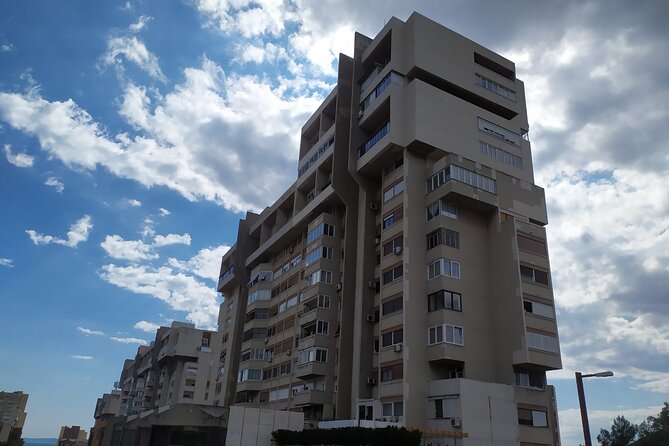
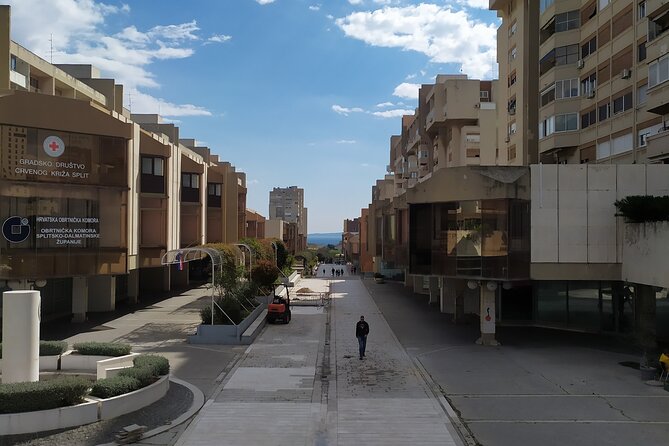
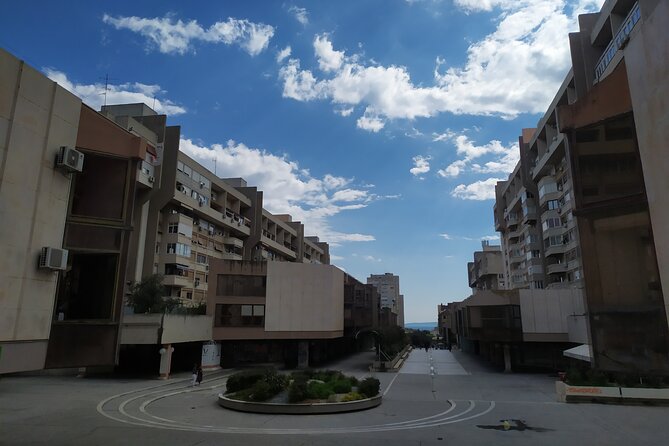
The longest stop is in Split 3, where you spend about an hour and 10 minutes. The neighborhood was planned to offer residents a place to live, work and rest. Its architects gave different buildings distinct designs, including one known as the Cruiser. The project was also featured in a Museum of Modern Art exhibition on Yugoslav architecture.
The longer visit makes sense here. Split 3 isn’t just a building to glance at from the vehicle; you’ll walk around and look at the architecture and the plan behind it. That gives the guide room to connect the neighborhood to housing policy, education, health care, the economy, social life and politics, with examples drawn from the Split area.
The tour also addresses Tito’s dictatorship. That balance is important: the neighborhood’s design may be admired as an urban project, while the political system that shaped life under it calls for a more critical view. You can look at the architecture and still ask who benefited, how services worked and what limits came with the system.
There is some free time at this stop, although the exact amount is not specified. That pause gives you a chance to take in the area rather than rush from one explanation to the next. If you enjoy architecture and urban planning, this is likely to be the tour’s most rewarding section. If you prefer a fast itinerary of famous landmarks, an extended neighborhood walk may feel less compelling.
Same coast, a different kind of day:
- From Split: Krka Waterfalls, Food & Wine Tasting Tour
★ 4.9 · 6,598 reviews - Split/Trogir: Blue Cave, Mamma Mia, Hvar and 5 Island Tour
★ 4.6 · 6,320 reviews - Blue Lagoon & 3 Islands Cruise with Lunch from Split
★ 4.5 · 5,756 reviews - Split: Old Town and Diocletian Palace Walking Tour
★ 4.9 · 4,727 reviews
Kopilica station and the end of Yugoslavia
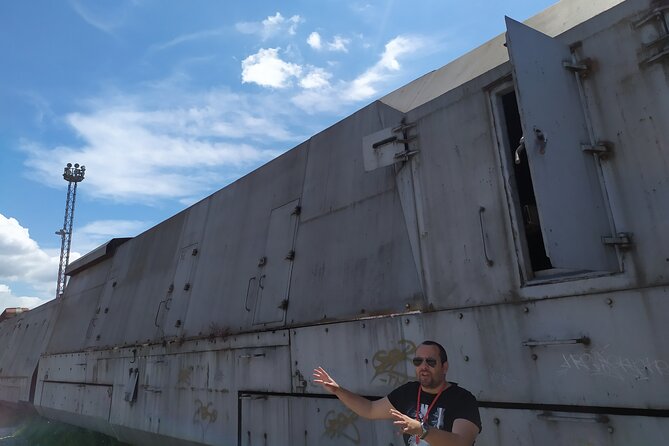
At Split Predgrađe, the tour finishes at Kopilica railway station. This final stop takes about 30 minutes and brings the discussion to the reasons Yugoslavia failed to survive, and to the violent breakup of the 1990s. An armored train displayed beside the railway serves as the visual focus.
The placement of this stop gives the tour a sobering finish. Earlier, you’ve seen how the communist state built and organized parts of daily life; here, the guide turns to the consequences of its collapse and the changed relations among the region’s nations and religions. The train is described as a symbol of the bloody end of Yugoslavia, so expect a serious discussion rather than a light closing stop.
This subject can be difficult, and the tour’s value depends in part on whether you want to engage with it. It doesn’t claim to settle every question about the breakup. Instead, it gives you a local framework for understanding why the end was violent and why its effects remained significant across southeast Europe.
What the small group and private ride add
The maximum group size is eight. That’s a practical advantage on a tour with several stops and a history teacher as guide: there is room to hear the explanations, ask questions and follow up on subjects that interest you. A previous one-person booking became a personalized outing, though you shouldn’t assume you’ll have the guide to yourself.
The vehicle is private and air-conditioned, and private transportation is included. That matters because the stops are dispersed. It saves you from planning transport between sites and gives the experience a more connected feel than trying to visit each location on your own. The tour does not list admission fees at these stops, and the itinerary describes the visits as free.
A local soft drink is included, one that was popular during communist Yugoslavia and remains popular today. It’s a small detail, but it fits the tour’s aim of tying history to familiar daily habits. Don’t expect a meal or a full refreshment break; the included drink is a modest extra.
Is $108.14 good value?
At $108.14 per person, this is not a budget city walk. You’re paying for a focused, three-and-a-half-hour experience with a local historian and history teacher, private transportation and a route that reaches places outside the standard Old Town circuit. For someone curious about Yugoslavia, architecture or modern Balkan history, the subject-specific guidance is the main value.
You could look up the buildings and visit some sites independently, but you would lose the connections among wartime Split, socialist consumer life, planned housing and the breakup of Yugoslavia. The guide’s interpretation is what turns several separate locations into one story. The small-group cap also helps make the price easier to justify if you value discussion over simply being driven around.
On the other hand, if you’re mainly interested in Split’s ancient sights, or you don’t have a particular interest in the communist period, this may not be the best use of your budget. The tour is specialized by design. You’re not paying for a general city overview or a broad sampler of Split’s main attractions.
The experience is booked on average about 10 days in advance, so leaving it to the last minute could limit your options. It requires good weather and a minimum number of participants. If poor weather or too few bookings cause cancellation, you’ll be offered another date or a refund. You can cancel for a full refund up to 24 hours before the start; later cancellations are not refundable.
Who should book this tour?
I’d recommend it to you if you have already set aside time for Split’s Old Town and want a more modern, locally grounded account of the city. It’s especially suited to anyone interested in Yugoslav history, socialist architecture, urban planning or the ways politics affected ordinary life. The small group and private ride make the route easier to follow, while the guide gives the places a shared context.
You may want to skip it if you prefer a relaxed stroll through the historic center, have little interest in 20th-century politics or would rather spend your time on a broad introduction to Split. This tour asks you to pay attention to buildings and history that can be less immediately familiar than the city’s ancient core.
If you book, go in ready for both architecture and difficult history. The strongest reason to choose this experience is not any single building, but the way it links Poljud, Koteks, Split 3 and Kopilica into a story about how Yugoslavia was built, lived in and lost.
FAQ
How long is the tour?
It lasts approximately three hours and 30 minutes.
What time does the tour start?
The stated start time is 9:00 am.
Where does the tour begin and end?
It begins at the bus stop on Trg Franje Tuđmana in Split and ends back at the meeting point.
How many people can join?
The maximum group size is eight travelers.
What language is the tour offered in?
The tour is offered in English.
Is transportation included?
Yes. Private transportation in an air-conditioned vehicle is included.
Is a drink included?
Yes. A typical local soft drink, popular during communist Yugoslavia and still popular today, is included.
Can I cancel for a refund?
You can cancel up to 24 hours before the start time for a full refund. Cancellations made less than 24 hours before the start are not refundable.
Just reviewed in Split
- Split City Walking Tour★ 5.0 · 5 reviews
- Split City Electric Bike Tour★ 5.0 · 68 reviews
- Split Cooking Class – Afternoon Edition Shared Activity★ 5.0 · 8 reviews
- Marjan Park & Split City Bike Tour★ 5.0 · 51 reviews
- Split: Blue Lagoon & 3 Islands Speedboat Tour – Small group★ 4.5 · 46 reviews
- Split Quest Experience: Discover the City★ 3.5 · 5 reviews
- Split: Blue Lagoon, Hvar, Brač, 6 Islands Boat Tour – Small Group★ 5.0 · 57 reviews
- Private transfer Split Airport to Split★ 5.0 · 28 reviews
Split Tours, compared.
Krka Waterfalls Trip with Boat Cruise and Swimming
Read our review →
Blue cave, Mamma Mia and Hvar, 5 islands speedboat tour
Read our review →
Blue Cave, Mamma Mia, Hvar and 5 Island Tour
Read our review →
Blue Lagoon & 3 Islands Cruise with Lunch from Split
Read our review →

Blue Lagoon Boat Party with DJs, Shots & After Party
Read our review →