Review · SPLIT TOURS
Experience Split With Local Professional Historian – Small Group
Diocletian’s Palace is not a ruin set apart from the city. It is the city’s old heart, threaded with lanes, squares, homes, shops, and cafés. On this two-hour walk, local historian Boris helps you read those layers, from Roman imperial quarters to the medieval streets Split still uses every day.
I like two things in particular: Boris’s picture book of historical images and 3D reconstructions makes the palace easier to picture, and the small group gives you room to ask questions. The walk also reaches beyond the palace to Riva, Fruit Square, and People’s Square, tying Roman landmarks to local life now.
One consideration: two hours is a brisk window for a site with centuries of history, and some of the most important interiors are viewed from outside. Admission tickets are not included, so plan extra time and budget if you want to go inside the cathedral or other paid sites afterward.
At a glance
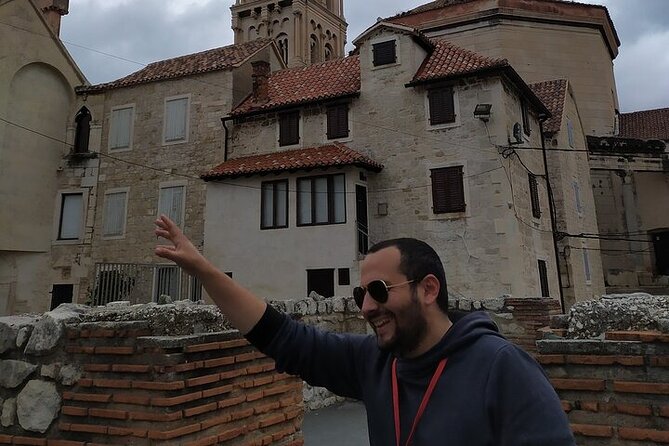
- A local historian leads the walk: Boris is a licensed guide with a master’s degree in history and a personal connection to Split.
- The route links Roman and medieval Split: Start at the Golden Gate and finish at People’s Square, with the Peristyle, Jupiter’s Temple, and Riva along the way.
- A visual aid makes the past clearer: Printed pictures and 3D images help you compare today’s buildings with earlier versions.
- Small group, maximum 12: A limited group makes it easier to hear, ask questions, and keep the conversation personal.
- Expect about two hours on foot: The listed stop times add up to two hours, though an engaged group may run longer.
- Admission is extra: The walk covers landmarks and explanations, but no entrance tickets are included.
Begin at the Golden Gate
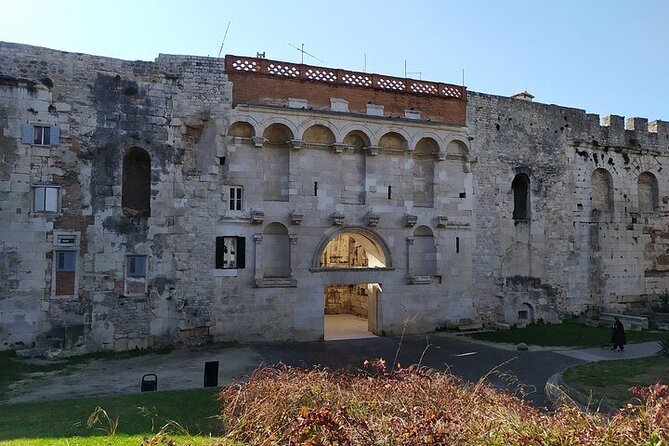
The Golden Gate is the northern entrance to Diocletian’s Palace, and the meeting point for the tour. Its name sounds grand, but the gate is made of stone, not gold. That small fact hints at the kind of detail that gives the walk its appeal: the tour does not just point at old walls; it helps you understand what you are looking at.
Boris introduces Split’s history here and explains the gate’s importance. This is a useful place to start because the palace was not originally a museum or a set of picturesque ruins. It was built as the residence of the Roman emperor Diocletian, and the surviving gates help you picture how people entered and moved through the complex.
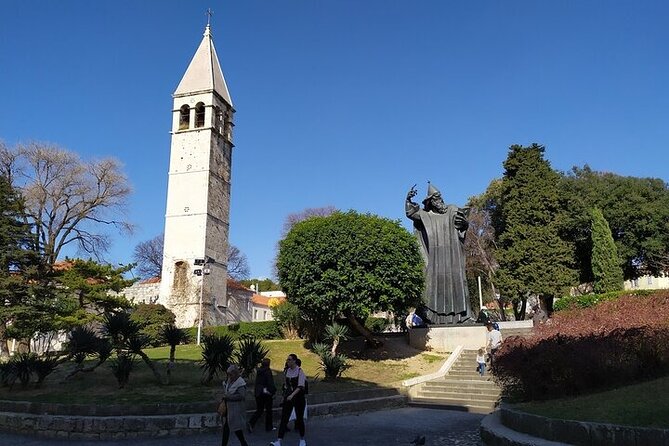
Across from the gate stands the statue of Gregory of Nin, one of Split’s best-known monuments. Boris tells the story of the historical figure and the sculptor who made the tall statue. The stop is short, but it gives you an early shift in perspective: Roman Split is only one layer of the city, and later Croatian history has its own landmarks and characters.
More tours in Split:
- Split: Krka Waterfalls Trip with Boat Cruise and Swimming
★ 4.8 · 10,519 reviews - From Split: Krka Waterfalls, Food & Wine Tasting Tour
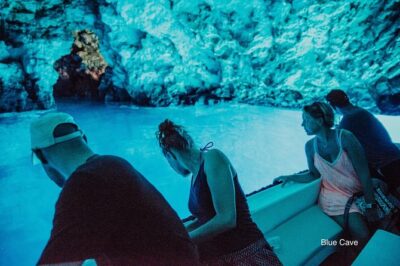
★ 5.0 · 9,326 reviews - Blue cave, Mamma Mia and Hvar, 5 islands speedboat tour
★ 5.0 · 7,150 reviews
Read the palace with a historian
The palace is the centrepiece of the walk, and for good reason. It is among the best-preserved Roman palace complexes, but its long life has made it more than a Roman site. Buildings changed use, Christianity reshaped the area, and a medieval city grew within the palace walls.
Boris explains the emperor’s role and the palace’s layout, then points out its significant areas and less obvious details. His picture book is a practical aid, not just a prop. When you stand beside ancient stone, it can be hard to imagine the original scale, decoration, or purpose. Reconstructed images give you something concrete to compare with the present-day remains.
The itinerary includes about 20 minutes for a general look at the palace’s main features, followed by further time at the Peristyle and central cellars. That split makes sense: you first get a broad outline, then spend longer at the place where the palace’s design and later city life come together.
Boris’s background as a history teacher comes through in the way the tour is described: expect questions, discussion, and explanations that connect landmarks to larger events. Families can take part too. The walk has been described as engaging for children as well as adults, and the visual material gives younger minds another way to follow along.
Stand in the Peristyle and look down
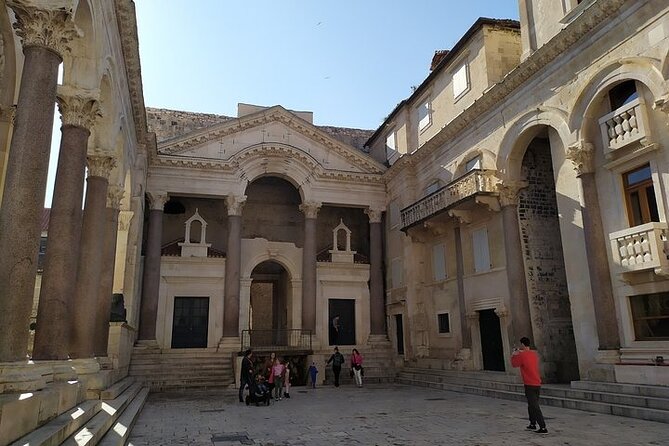
The Peristyle was the palace’s central gathering place, and it remains one of the clearest spots for understanding how the complex worked. Boris explains its function and importance, including how it connected some people while setting them apart from the emperor. From the centre of the square, you can look around and make sense of the surrounding buildings as parts of a plan rather than isolated sights.
This is also where the tour traces the effects of Christianity on the palace and its buildings. The point is not simply that one era replaced another. The old structures were adapted, and the changing uses of the space helped shape the city you see today.
The route then goes into the central part of the palace cellars, also called the substructure. Boris discusses how the cellars were used through history and why they matter to Split. This is one of the most useful moments for understanding the palace’s scale: what survives above ground is only part of the story, and the lower levels help explain the structure beneath the city.
The nearby Triclinium brings everyday habits into the picture. Here Boris talks about Roman and imperial dining, including the organization of the emperor’s dining room. It is a welcome change from dates and rulers. Food and room layout make the past feel more human, even if the subject is an emperor’s formal meals rather than an ordinary household supper.
See Jupiter’s Temple and the cathedral from outside
At Jupiter’s Temple, the tour focuses on Roman religion and the role temples played in imperial residences. You view the temple from outside, while Boris explains its importance. That distinction matters if you are planning your time: this is an interpretive stop, not a ticketed interior visit.
The Cathedral of Saint Domnius is also viewed from outside. Boris points out significant features and explains the building’s story, while noting details to watch for if you decide to visit the interior on your own. That makes the stop a useful preview, especially if you want to choose later between spending time inside the cathedral or continuing to explore the palace streets.
The itinerary gives each of these stops about ten minutes. That is enough for a clear introduction, not an exhaustive visit. If architecture or religious history is a major interest, you may want to return independently and allow more time. Admission is not included in the tour price.
Same coast, a different kind of day:
- From Split: Krka Waterfalls, Food & Wine Tasting Tour
★ 4.9 · 6,598 reviews - Split/Trogir: Blue Cave, Mamma Mia, Hvar and 5 Island Tour
★ 4.6 · 6,320 reviews - Blue Lagoon & 3 Islands Cruise with Lunch from Split
★ 4.5 · 5,756 reviews - Split: Old Town and Diocletian Palace Walking Tour
★ 4.9 · 4,727 reviews
Enter the Vestibule, then follow the city to the sea
The Vestibule was the entrance to Diocletian’s private chambers. Boris explains how it was decorated and what purpose it served. The stop helps distinguish the emperor’s private areas from the more public parts of the palace, an important contrast in a complex designed around both access and status.
From there, the walk leaves the palace’s ancient core for Riva, Split’s main promenade. The five-minute stop is brief, but the change of setting is valuable. Boris explains how the waterfront promenade developed over the centuries and why it became a central place for local life. It is a reminder that Split’s story did not stop when Roman power faded.
You then continue to Fruit Square, officially Trg Braće Radić. Boris explains the source of its familiar name and points out the monument at its centre and notable buildings around the square. The stop gives you a closer look at the smaller public spaces that make the old town feel like a lived-in neighbourhood rather than a single archaeological site.
Finish at People’s Square with local suggestions
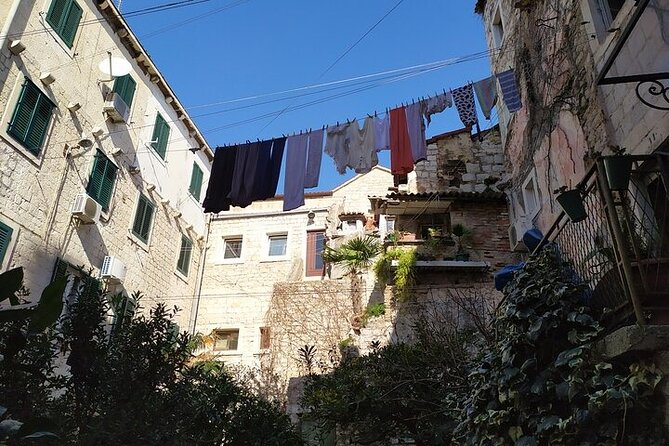
The final stop is People’s Square, or Pjaca, a central place for city life from medieval times to the present. Boris talks about the square’s history and its surrounding buildings, including the old City Hall. It is a fitting endpoint: the route has moved from the palace’s imperial beginnings through religious and medieval changes to public life in the modern city.
Before the tour ends, Boris suggests other places to see that are not part of the walk. His advice can help you shape the rest of your time in Split, and the personal stories he shares add a local view of how the city has changed across generations. The tour also includes help taking photos, a useful touch if you want a group picture without asking a stranger.
The finish at Pjaca is practical, too. You are in the old town, with the main sights and lanes close at hand. You can continue exploring on your own, return to a landmark for a longer visit, or follow a recommendation for coffee or a meal.
What the two-hour format means for your day
The route lists ten stops, with brief visits ranging from five to 20 minutes. Taken together, the scheduled time is about two hours. It is a concentrated introduction, not a slow, private examination of every building.
In practice, questions and conversation can stretch the walk. One account describes a tour that lasted closer to two and a half hours, with plenty of time for discussion. If you have a tight schedule, leave a little breathing room before your next commitment. The guide’s interactive style is part of the appeal, and it would be a shame to spend the whole walk watching the clock.
The maximum group size is 12. That is small enough for a more direct exchange than you would get in a large crowd, while still sharing the guide’s time with other people. If the group is smaller, the experience may feel more like a conversation; in some cases, the tour has even been private. The group size can vary, so do not book on the assumption that you will have Boris to yourself.
Is $38.62 good value?
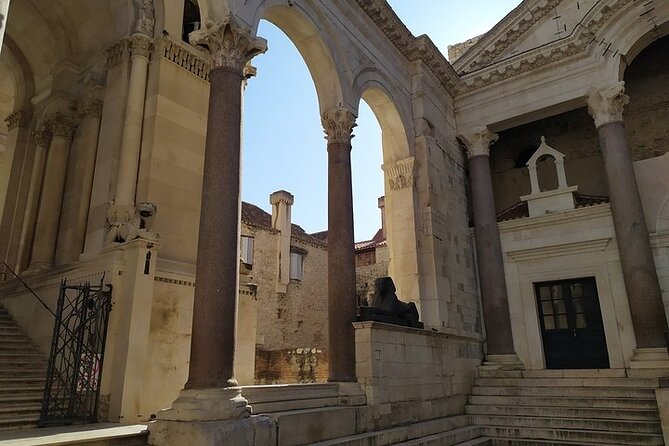
At $38.62 per person, this tour is a sound buy if you want context rather than just a route through the old town. You are paying for a licensed local guide with a master’s degree in history, a structured walk through the palace and surrounding squares, and visual material that helps explain how the site once looked.
The value is strongest if this is your first visit to Split or if the Roman remains feel hard to interpret on your own. Boris connects the emperor’s palace to later medieval life and present-day local culture, and he is known for answering questions and sharing personal stories. The recommendations for places to eat and see afterward can also help you make better use of the rest of your stay.
The price does not include admission tickets. If you want to enter the cathedral or any other paid attraction, set aside extra money and time. The tour itself is mostly an outdoor walking introduction, with the cellars included as a stop in the route, so check any separate admission requirements before making plans around an interior visit.
Who should book this walk?
I would book this tour early in a Split stay. It gives you a framework for the palace, the old town, and the waterfront, so later walks are easier to follow. The guide’s local perspective is especially useful if you want to understand how people live in and around a monument that is still part of the city.
History fans will appreciate the detail, but you do not need to arrive as a specialist. The tour aims to make the subject engaging rather than solemn, and the guide’s questions and personal stories help keep the pace lively. Families with children may also find the picture book and interactive approach useful.
You may want a different plan if you prefer to explore at your own pace, spend a long time inside each monument, or avoid group walks. This route covers many stops in a short period, and the cathedral and Jupiter’s Temple are viewed from outside. But if you want an informed, friendly orientation with space for questions, the small-group format offers a strong balance of history and local life.
Booking confirmation is provided at the time of booking, and the tour is offered in English. Free cancellation is available up to 24 hours before the start time. The experience requires good weather and a minimum number of participants; if poor weather or a shortfall in numbers cancels it, you are offered another date or a full refund.
FAQ
How long is the tour?
It is listed as approximately two hours. The route’s scheduled stops total about two hours, though discussion and questions can make the walk longer.
Where does the tour start?
It starts at the Golden Gate, at Dioklecijanova 7 in Split.
Where does the tour end?
It ends at People’s Square, also known as Pjaca Square.
What language is the tour offered in?
The tour is offered in English.
How large is the group?
The maximum group size is 12 people.
Who guides the tour?
The tour is led by a local professional licensed guide with a master’s degree in history. Boris is the guide named in the tour information and shared accounts of the experience.
Are admission tickets included?
No. Admission tickets are not included in the tour price.
Does the tour include a visual guide to the palace?
Yes. The guide uses a book with pictures and 3D reconstruction images to help explain Split’s past.
Is the tour suitable for children?
Most people can participate, and accounts of the tour describe children taking part in its questions and discussions. The tour information does not give a minimum age.
What is the cancellation policy?
You can cancel for a full refund up to 24 hours before the start time. Cancellations or changes made less than 24 hours before the start are not accepted.
Just reviewed in Split
- Split City Walking Tour★ 5.0 · 5 reviews
- Split City Electric Bike Tour★ 5.0 · 68 reviews
- Split Cooking Class – Afternoon Edition Shared Activity★ 5.0 · 8 reviews
- Marjan Park & Split City Bike Tour★ 5.0 · 51 reviews
- Split: Blue Lagoon & 3 Islands Speedboat Tour – Small group★ 4.5 · 46 reviews
- Split Quest Experience: Discover the City★ 3.5 · 5 reviews
- Split: Blue Lagoon, Hvar, Brač, 6 Islands Boat Tour – Small Group★ 5.0 · 57 reviews
- Private transfer Split Airport to Split★ 5.0 · 28 reviews
Split Tours, compared.

Krka Waterfalls Trip with Boat Cruise and Swimming
Read our review →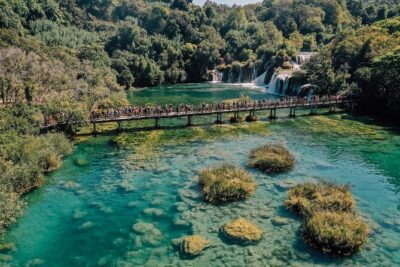
Blue cave, Mamma Mia and Hvar, 5 islands speedboat tour
Read our review →
Blue Cave, Mamma Mia, Hvar and 5 Island Tour
Read our review →
Blue Lagoon & 3 Islands Cruise with Lunch from Split
Read our review →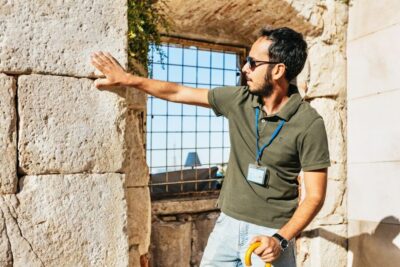

Blue Lagoon Boat Party with DJs, Shots & After Party
Read our review →