
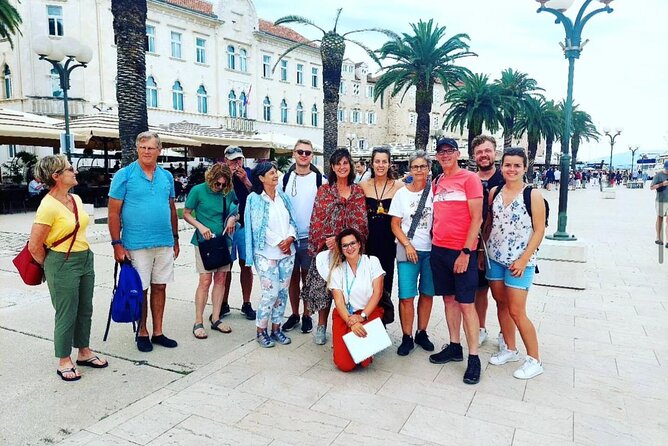
Review · SPLIT PRIVATE TOURS
Best of Split & Trogir: Private VIP Tour with Local Guide
Split’s Diocletian’s Palace is not a ruin set apart from daily life. It is part of the old town, with ancient columns, a cathedral and shops folded into the same streets. This private tour pairs those layers with a visit to Trogir, a compact Adriatic town whose central square and Venetian-era buildings tell a different chapter of Dalmatian history.
I like two things in particular: a private guide can help you make sense of the palace’s jumble of Roman and later architecture, and the trip gives you a useful comparison between Split and Trogir in one day. Guides Kristina and Andrea are among the names associated with the tour; Kristina is described as sharing local traditions and personal stories, while Andrea helped a group navigate crowds.
The main consideration is the pace. The listed stops are generally 15 minutes each, and several sights have admission fees that are not included. If you want a long visit inside every church, palace and fortress, this may feel like a sampler rather than a slow exploration.
- Two historic towns in one six-hour outing: Split’s imperial palace and Trogir’s Venetian-influenced old town offer distinct settings.
- Private format: Only your party joins the activity, so you can focus your questions on the sights that interest you.
- A guide who can add local context: Kristina and Andrea are named guides, and personal stories and help with crowds are among the features associated with their tours.
- Short visits at many stops: The listed visits are about 15 minutes each, which makes for a broad overview, not a deep visit to every monument.
- Some admission fees are extra: The palace substructures, St. Lawrence’s Cathedral and Kamerlengo Fortress are marked as not including admission.
Two towns, two different chapters of Dalmatia
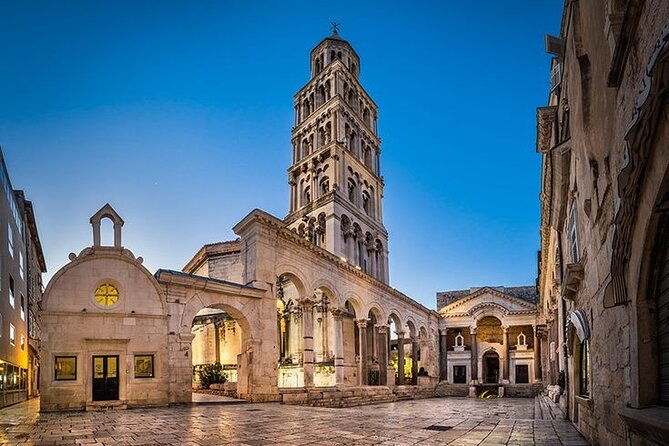
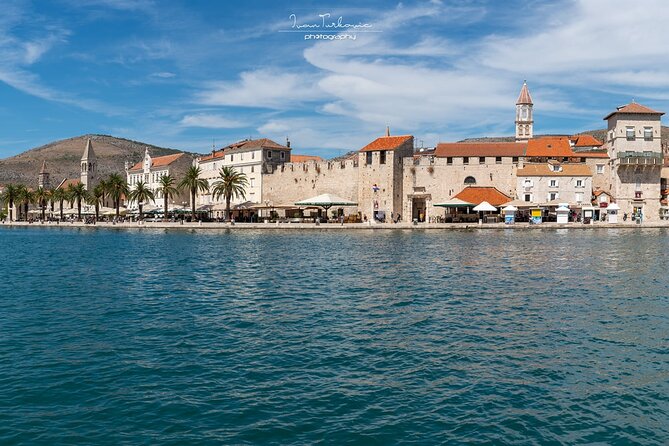
This tour links Split and Trogir, but they do not feel like two versions of the same old town. Split grew around the late Roman palace of Emperor Diocletian, whose remains still shape the city’s center. Trogir’s old town is a small island settlement known for its Venetian-era character and UNESCO-listed monuments.
That contrast gives the day a useful shape. In Split, you move through a palace that became a city. In Trogir, the focus shifts to a medieval civic square, a major cathedral and a coastal fortress. A guide can connect the buildings to the people and purposes behind them, rather than leaving you to treat each stop as a photo backdrop.
The tour is private, so your group has the guide to itself. That matters in a place like Diocletian’s Palace, where the central sights sit close together but the lanes can be crowded and the building history is layered. One account of the tour specifically notes that the guide helped the group move through crowds with ease. That is a practical advantage, not just a nice extra.
The outing lasts about six hours. Since the listed stops are short and the two towns are separate, the day is designed to cover ground rather than linger at length in every interior. The order can vary: one group began in Trogir, even though the listed route begins with Split. If you have a strong preference, ask the provider about the sequence when arranging your tour.
At the Peristyle, the palace becomes a city
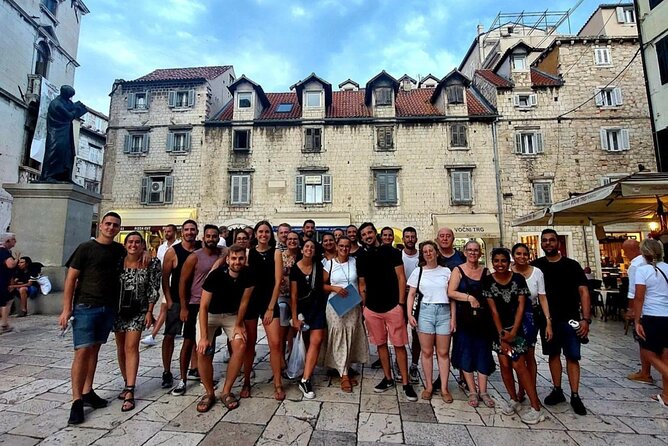
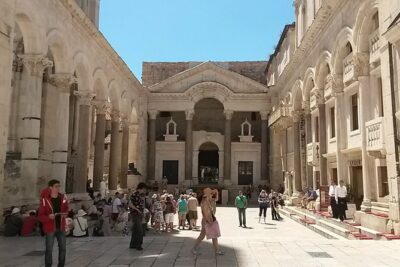
The Peristyle is the natural starting point for understanding Diocletian’s Palace. This rectangular court sits at the crossing of the complex’s two main roads and was intended as its heart. Colonnades frame the open space, making it easier to picture the formal setting the emperor’s residence once required.
You get about 15 minutes here. That is enough to orient yourself and take in the proportions, but not much time for a leisurely pause if the square is busy. The central location makes the Peristyle a useful anchor for the nearby cathedral and Temple of Jupiter, both of which belong to the same palace complex.
The Cathedral of Saint Domnius is one of the most striking examples of how the palace changed over time. It was consecrated around the turn of the seventh century and is regarded as the oldest Catholic cathedral still in use in its original structure, without a near-complete later reconstruction. Its bell tower dates from the 12th century, so even the building’s most recognizable vertical feature belongs to a later era.
The route also includes the Temple of Jupiter, built between 295 and 305 as part of the palace. Its location near the Peristyle makes it a compact but telling stop: the palace was not only a home, but an imperial complex with religious and ceremonial spaces. The supplied details do not specify an admission fee for this stop, so check what is included before you go if entering the temple is important to you.
More private tours in Split:
- SPLIT-PRIVATE Walking Tour of Diocletian’s Palace & Old Town
★ 5.0 · 467 reviews - Private Krka Waterfalls tour with 30min Boat Cruse
★ 4.0 · 458 reviews - Split by Private Electric Rickshaw – Palace & Hidden Gems
★ 5.0 · 412 reviews
From the worn toe to the palace’s underground halls
The statue of Gregory of Nin, sculpted by Ivan Meštrović, offers a lighter stop amid the Roman remains. At 8.5 metres tall, it is hard to miss. Its most famous detail is the toe, polished smooth by people who rub it for good luck. You can decide for yourself whether the ritual works; the shining bronze at least makes the custom easy to spot.
The visit is listed at 15 minutes, with no admission charge. It is a quick stop, but it gives your guide a chance to explain how Croatian national and religious history is remembered in public spaces. The statue also offers a change of scale and subject after the tight cluster of palace-era buildings.
The Cellars of Diocletian’s Palace, also called the basement halls, are among the most significant ancient remains in the complex. They lie beneath the palace’s southern end and once supported the emperor’s private apartments. Their preservation makes them unusually helpful for imagining the layout above, even when the rooms themselves feel more like structural foundations than furnished living quarters.
Allow for the extra entrance cost here: admission is not included. The listed stop is about 15 minutes, so consider whether you want to pay for a brief visit or return later for more time. For many people, the cellars are the clearest way to understand the scale and engineering of the palace, but the tour’s short stop may not satisfy anyone hoping to examine every chamber at leisure.
Trogir’s central square and its civic life
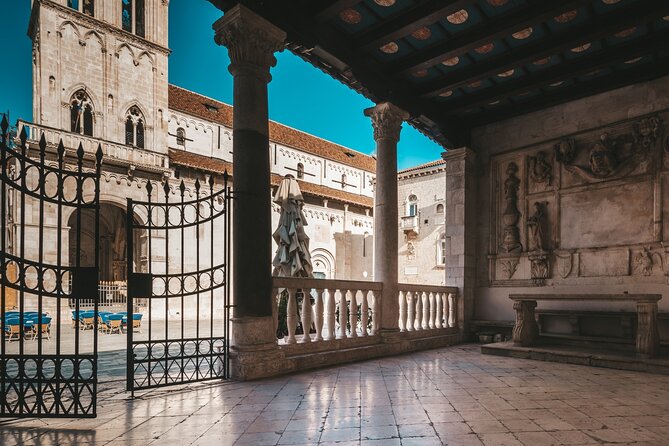
Trogir’s main square, also called John Paul II Square, gives you a concentrated introduction to the old town. The square is framed by notable historic buildings, including the Loggia and Clock Tower, and reflects the town’s long public life. The Loggia served as a place where people met, legal matters were discussed and important decisions were announced.
The Loggia’s six pillars have decorated capitals, and its wall includes a relief called The Relief of Justice, made by Nicholas Florentino. In summer, a nearby coffee bar can make the pillars harder to see clearly. That small detail is worth knowing: the square is a working public place, not a museum room cleared for viewing.
The Central Square stop is listed at 15 minutes and is free to enter. That gives you time to take in the main facades and hear an explanation, though a longer independent visit would let you linger over the reliefs and surrounding buildings. Trogir’s compact scale makes it a satisfying counterpoint to Split, where the palace complex can feel like a maze.
St. Lawrence’s Cathedral and the layers of Trogir
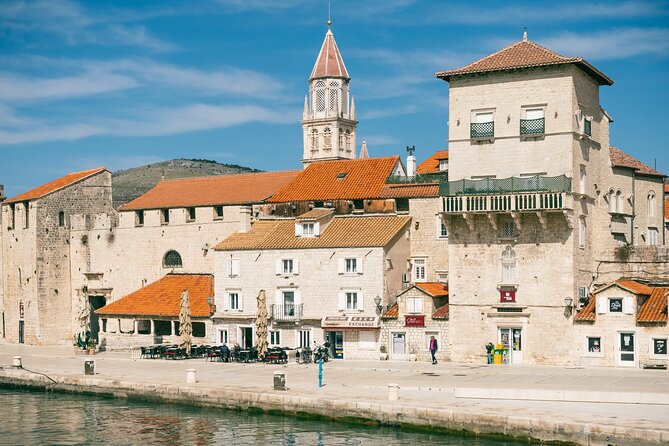
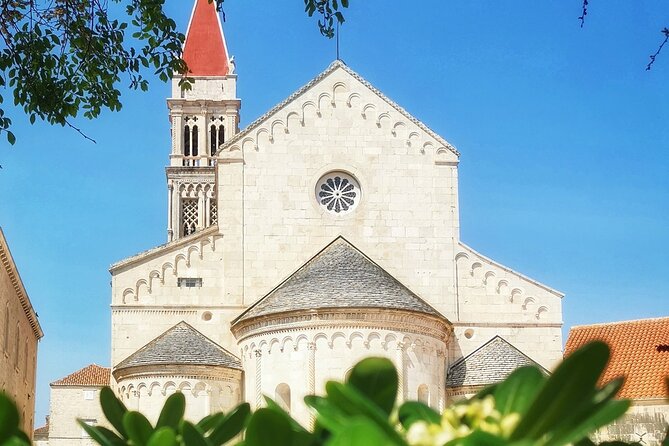
The Cathedral of St. Lawrence is Trogir’s most imposing monument. It is a triple-naved basilica whose Romanesque-Gothic design reflects the fact that construction lasted for several centuries. Rather than representing one clean architectural moment, the building records successive styles in Dalmatia.
Admission is not included, and the scheduled stop is about 15 minutes. If you are drawn to church architecture, you may want to check the current entry arrangements and decide whether you are comfortable with a short visit. Even from the outside, the cathedral helps explain why Trogir’s small old town has such a notable architectural profile.
The schedule also includes Palace Čipiko, the largest residential palace in Trogir. It belonged to the influential Čipiko family and is an example of Gothic-Renaissance architecture. The palace speaks to the wealth and status of the town’s prominent families, adding a domestic counterpart to the public and religious buildings around the square.
Admission to the palace is listed as not included, and the stop is about 15 minutes. Treat it as a chance to learn what the building represents, rather than assuming the tour includes a full interior visit. The listed stop at the Town Loggia gives the day another look at Trogir’s civic traditions, with no admission charge.
More guided tours in Split:
- From Split: Plitvice Lakes National Park Guided Tour
★ 5.0 · 3,002 reviews - From Split: Plitvice Lakes Guided Tour with Entry Tickets
★ 4.9 · 2,468 reviews - From Split: Plitvice Lakes National Park Guided Tour
★ 5.0 · 2,355 reviews - Plitvice Lakes National Park Guided Day Tour from Split
★ 5.0 · 1,948 reviews
Kamerlengo Fortress and the Adriatic setting
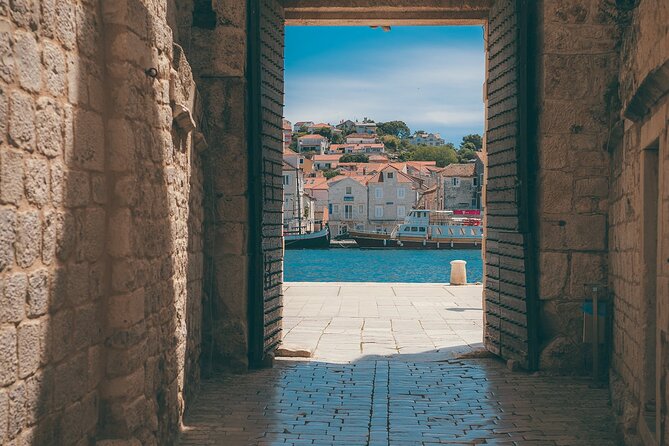
Kamerlengo Fortress was built in the 15th century under Venetian rule to defend Trogir from naval attacks. Its position by the water links the old town’s architecture to its strategic purpose. From the fortress, you can see the old town, marina and nearby islands, making this one of the route’s clearest viewpoints.
Admission is not included, and the stop is listed at 15 minutes. The short visit may be enough to appreciate the fort’s shape and setting, but anyone wanting more time for the views should consider returning independently if their plans allow. The fortress gives Trogir a maritime dimension that a walk around the square alone would miss.
What the private format is worth
At $228.78 per person, this is a substantial half-day expense. The value depends less on the number of stops than on how much you want a guide’s interpretation and the convenience of seeing two towns in one outing. A private format gives your group its own guide, and group discounts may be available. Pickup is offered, though the details of where and how it works are not specified here.
This price does not mean every entrance is covered. The Cellars of Diocletian’s Palace, St. Lawrence’s Cathedral and Kamerlengo Fortress are specifically marked as having admission not included; the same applies to Palace Čipiko. Factor those extra costs into your budget if you plan to enter. The Peristyle, Gregory of Nin statue, Trogir Central Square and Town Loggia are listed as free stops.
The experience is offered in English and uses a mobile ticket. Booking demand appears to be substantial: the tour is booked, on average, 172 days in advance. That is an average, not a guarantee that you must book that early, but it is a good reason to check availability well ahead if your dates are fixed.
Who will get the most from this day
I would consider this tour if you have limited time in Split and want a guide to connect the palace’s Roman foundations with the later history of Trogir. It suits people who value local context, want the flexibility of a private group and are comfortable with a brisk sequence of short stops. The personal stories attributed to Kristina, and the help navigating crowds associated with Andrea, suggest the guide can add more than dates and architectural labels.
It is less suited to someone who prefers to spend an hour inside each monument or wants a slow, unstructured day. The stop timings make the tour a strong orientation, but they leave little room for extended independent browsing. If interiors matter most to you, choose in advance which paid sites deserve your time and be ready to continue exploring after the guided portion.
The tour allows service animals, and most people can participate. Free cancellation is available up to 24 hours before the start time; changes or cancellations inside that window are not accepted for a refund. Those terms are worth keeping in mind when booking well ahead.
Should you book it?
Book this tour if you want one guide, one private outing and a clear introduction to both Split and Trogir. Its strongest value is the combination: the Peristyle, palace substructures and old-town streets in Split, followed by Trogir’s square, cathedral and fortress. The guide’s local stories and crowd navigation can make a busy day easier to follow.
Skip it, or plan extra time afterward, if your priority is a slow visit inside every monument. With short scheduled stops and some entry fees on top of the price, this works best as a guided overview rather than an all-access, lingering tour.
FAQ
How long is the tour?
It lasts approximately six hours.
What is the price?
The listed price is $228.78 per person. Group discounts are offered.
Is this a private tour?
Yes. Only your group participates.
Is pickup offered?
Yes, pickup is offered. Specific pickup details are not provided here.
What language is offered?
The tour is offered in English.
Are entrance fees included?
Not for the Cellars of Diocletian’s Palace, St. Lawrence’s Cathedral, Kamerlengo Fortress and Palace Čipiko. The Peristyle, Gregory of Nin statue, Trogir Central Square and Town Loggia are listed as free.
Can I cancel for a refund?
Yes. You can cancel up to 24 hours before the experience’s start time for a full refund. Cancellations or changes made less than 24 hours beforehand are not accepted.
How far ahead is the tour usually booked?
On average, it is booked 172 days in advance.
Just reviewed in Split
- Split City Walking Tour★ 5.0 · 5 reviews
- Split City Electric Bike Tour★ 5.0 · 68 reviews
- Split Cooking Class – Afternoon Edition Shared Activity★ 5.0 · 8 reviews
- Marjan Park & Split City Bike Tour★ 5.0 · 51 reviews
- Split: Blue Lagoon & 3 Islands Speedboat Tour – Small group★ 4.5 · 46 reviews
- Split Quest Experience: Discover the City★ 3.5 · 5 reviews
- Split: Blue Lagoon, Hvar, Brač, 6 Islands Boat Tour – Small Group★ 5.0 · 57 reviews
- Private transfer Split Airport to Split★ 5.0 · 28 reviews
Split Private Tours, compared.
Private Krka Waterfalls tour with 30min Boat Cruse
Read our review →
Private Blue cave, Mamma Mia and Hvar, 5 islands tour from Split
Read our review →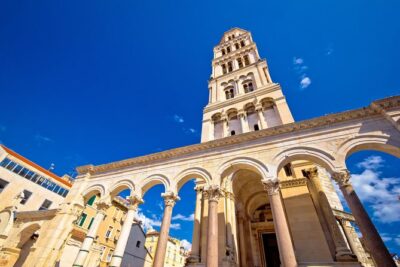

Private Boat Tour by local expert – Create Your Itinerary
Read our review →
Split airport to Split Private transfer to 8 pax (Door to Door any location)
Read our review →Browse the lists this tour appears in