
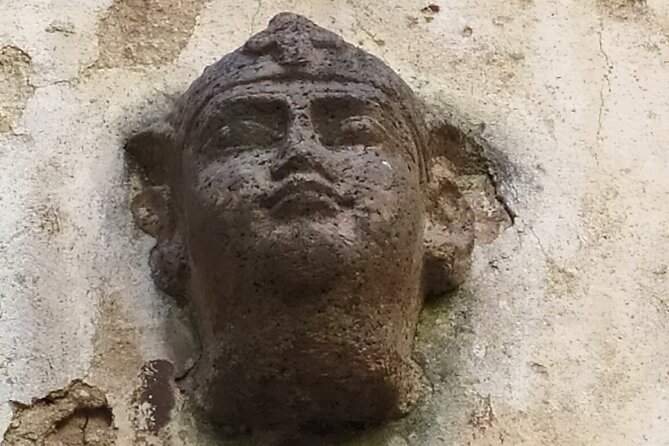
Review · SPLIT PRIVATE TOURS
Experience Split With Local Professional Historian – Private
Split’s old town grew inside and around a Roman emperor’s retirement palace. On this private walk, historian Boris traces that change from the Golden Gate through the Peristyle and on to the medieval squares, linking the stones around you to the people who used them.
I like two things about this tour’s design: Boris has a master’s degree in history, and his display book uses 3D reconstructions to help you picture buildings that have changed over time. I also like that it is private, so you can ask questions and request a gentler pace. One consideration: the tour lasts about two hours, and admission tickets are not included, so check in advance if you want to enter any sites.
Key points
- Start at the Golden Gate: Meet at the northern entrance to Diocletian’s Palace, across from the Gregory of Nin statue.
- Follow Roman and medieval Split: The route covers palace landmarks, then continues to Riva, Fruit’s Square, and Pjaca.
- Get history with visual context: Boris brings a display book with 3D reconstructions and pictures.
- Book for your own group: The listed price is $156.21 for up to 15 people, not a per-person rate.
- Expect a flexible, question-friendly pace: The guide has adjusted timing for a delayed flight and made room for rest stops.
- Plan for a walking tour, not an entry pass: Several landmarks are viewed from outside, and admission tickets are not included.
A Roman palace that became a city
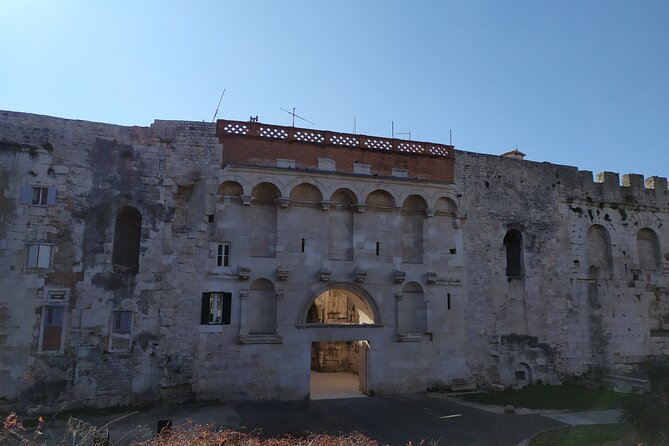
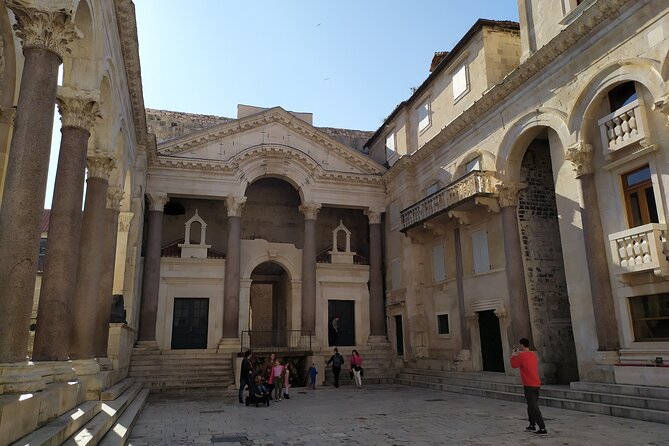
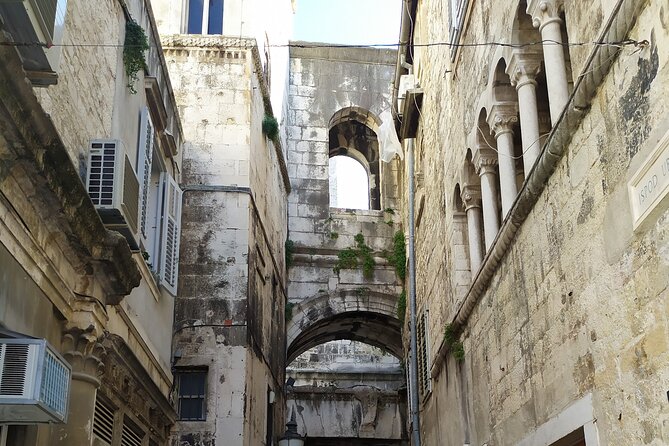
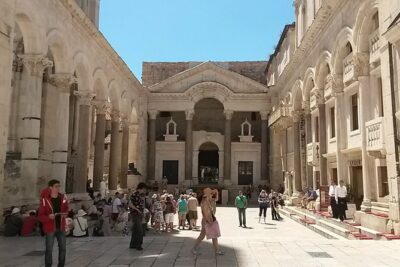
Diocletian’s Palace is not a freestanding ruin set apart from modern life. It forms the core of Split’s old town, with streets and squares threaded through its ancient structure. That makes a guided walk useful: instead of seeing a jumble of old stone, you can follow how an imperial residence became part of a living city.
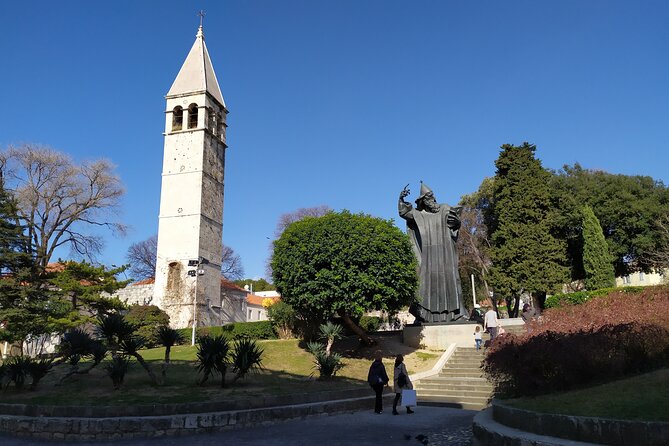
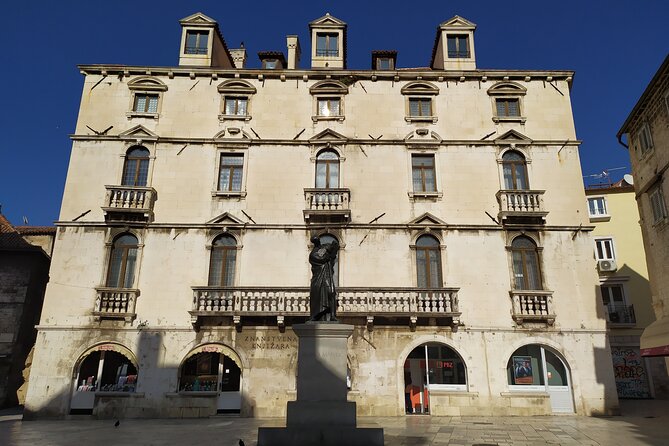
The route starts at the Golden Gate, the palace’s northern entrance. Its name may suggest gold, but the gate is stone. Across from it stands the monument to Gregory of Nin, a useful first example of how Roman, medieval, and later history overlap in Split.
From here, the walk moves through the palace’s central spaces, including the Peristyle, Jupiter’s Temple, the Vestibule, and parts of the cellars. It then steps beyond the palace’s core to Riva and the old town squares. The full route is planned for about two hours, with ten stops and time to ask questions along the way.
More private tours in Split:
- SPLIT-PRIVATE Walking Tour of Diocletian’s Palace & Old Town
★ 5.0 · 467 reviews - Private Krka Waterfalls tour with 30min Boat Cruse
★ 4.0 · 458 reviews - Split by Private Electric Rickshaw – Palace & Hidden Gems
★ 5.0 · 412 reviews
The Golden Gate and Gregory of Nin
At the Golden Gate, Boris introduces the history of Split and explains why this entrance mattered. Beginning here gives you a clear point of orientation before you enter the tangle of lanes inside the palace. You can also look across at the statue of Gregory of Nin, whose story becomes the subject of the next stop.
The statue is described as the highest monument in Split, and Boris discusses both Gregory and the sculptor who made it. This short pause adds a human figure to the city’s long timeline. It also sets up a useful contrast: the palace began as an imperial project, while later periods left their own marks on the city and its public spaces.
These first two stops take about 25 minutes in total. That is enough time for context and questions, but not a long lecture at each landmark. If you have a particular interest in Split’s religious or political history, this is a good moment to ask Boris to expand on it.
Inside Diocletian’s Palace
The palace is the main event, and the tour gives it more time than any other part of the route. Boris explains its connection to Emperor Diocletian, then points out important sections and less obvious details as you move through the complex. A display book with 3D reconstructions and pictures can help you imagine the original arrangement, especially where the present-day buildings make the ancient plan hard to read.
The Peristyle is the palace’s central gathering place and a key stop for understanding how the residence worked. From this open space, Boris discusses its role as a place that connected people to the emperor while also marking a division between them. Look around as he explains the layout: the setting makes more sense when you can see how the surrounding buildings frame the square.
The tour also covers the changes that followed the spread of Christianity. The palace did not stay frozen in its original Roman form; its buildings and uses shifted over time. That transition is one of the most useful themes of the walk, since it explains why you see Roman structures alongside later religious and civic landmarks.
Cellars, dining rooms, and Jupiter’s Temple
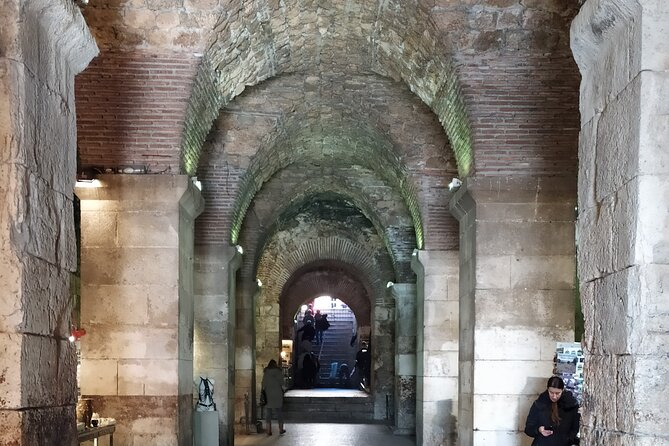
From the Peristyle, the route enters the central part of Diocletian’s cellars, also called the palace’s substructure. Boris talks about how the cellars were used through different periods and why they matter to Split’s history today. Their lower-level spaces also help you grasp the scale of the palace beyond what is visible from the street.
The route includes the Triclinium, where the guide explains Roman dining habits and the organization of the emperor’s dining room. It is a small but helpful shift from grand architecture to daily life: history becomes easier to picture when it includes how people ate, as well as where they lived and governed.
Jupiter’s Temple is viewed from outside. Boris explains the place of religion in Roman life and the role of this particular temple. The outside-only visit is worth keeping in mind if you are hoping to see interiors. No admission tickets are included, and you should ask the provider what access is possible during your tour if entering a site matters to you.
More tours in Split:
- Split: Krka Waterfalls Trip with Boat Cruise and Swimming
★ 4.8 · 10,519 reviews - From Split: Krka Waterfalls, Food & Wine Tasting Tour
★ 5.0 · 9,326 reviews - Blue cave, Mamma Mia and Hvar, 5 islands speedboat tour
★ 5.0 · 7,150 reviews - From Split: Krka Waterfalls, Food & Wine Tasting Tour
★ 4.9 · 6,598 reviews
The Mausoleum and the Vestibule
The former mausoleum is now the Cathedral of Saint Domnius. The tour’s stop is outside, where Boris points out significant features and explains the building’s story. He can also flag details to look for if you decide to visit the interior on your own afterward. That is practical advice: you get context before deciding whether to spend extra time and money inside.
The Vestibule was the entrance to Diocletian’s private chambers. Boris explains its function and how its decoration reflected the importance of the rooms beyond. This stop helps complete the picture of the palace as a residence, not just a monumental collection of courtyards and temples.
Taken together, the palace stops offer a broad overview rather than a detailed visit to every room. That is appropriate for a two-hour walk through a working old town. If you want to spend a long time inside the cathedral or another site, plan a separate visit.
Riva, Fruit’s Square, and Pjaca
After the palace, the route reaches Riva, Split’s main waterfront promenade. Boris describes how it developed over the centuries and why it became a central place for local life. The stop is brief, about five minutes, so treat it as a short introduction rather than a long waterfront stroll.
Fruit’s Square, also called Trg Brace Radic, is a smaller square with a name that invites a question. Boris explains why it is known as Fruit’s Square and points out its central monument and nearby sights. It offers a change of scale after the palace’s large ceremonial spaces.
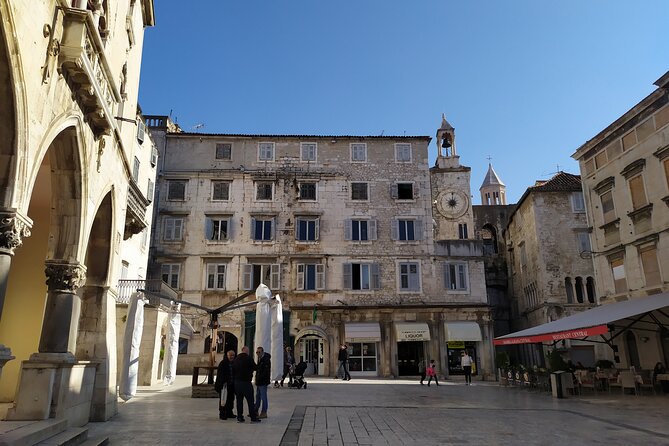
The tour ends at Pjaca, or People’s Square, at Narodni trg. This has been a center of city life from medieval times to the present. Boris discusses the square and surrounding buildings, including the old City Hall, and can suggest other places to see afterward. Ending here makes sense: the route moves from the imperial center to the civic heart of later Split.
What makes a private guide worthwhile
A private tour is most useful when you want to steer the conversation. You can ask Boris to explain a Roman feature in more detail, or keep moving if your group would rather focus on the broad story. The private format also suits a mixed group: one person may be keen on archaeology while another prefers people, customs, and everyday life.
Boris’s history degree and use of visual material give the tour a clear teaching angle without requiring you to arrive with background knowledge. Past tour arrangements also show practical flexibility. He adapted the schedule for a group delayed by a flight and helped another visitor find places to sit after a fall. That does not guarantee every request can be accommodated, but it is a reassuring sign if timing or pace is a concern.
The tour is in English, and it is listed as suitable for most people. It is still a walking tour through the old town, so consider your own comfort with being on your feet for about two hours. If someone in your group needs more frequent rests, contact Boris before the tour and discuss a suitable pace.
Is $156.21 good value?
The listed price is $156.21 per group of up to 15, which makes the value depend on your group size. For two people, that works out to about $78.11 each. For a full group of 15, it is about $10.41 each. You are paying for a private guide rather than a seat on a shared tour, so the price makes more sense if you can split it among several people.
The main value is interpretation. You get two hours of context across Roman and medieval Split, a route that links major landmarks to later city life, and a guide who can answer your questions. The 3D images can make the palace’s original form easier to understand than a quick look at weathered stone alone.
The price does not include admission tickets. Some stops are explicitly outside visits, including Jupiter’s Temple and the Cathedral of Saint Domnius. If you plan to enter sites after the walk, add that cost and time to your budget rather than treating the tour price as an all-inclusive ticket.
Timing and practical details
The meeting point is the Golden Gate at Dioklecijanova 7. The tour ends at People’s Square, Narodni trg 16, so you finish in the old town rather than returning to the starting point. The listed duration is about two hours, and the activity is offered in English with a mobile ticket.
The provider lists weekday hours from 5:00 to 7:00 p.m. for the stated operating period, while also noting that start times can be flexible. Contact the provider before the tour if you need a different time. That is especially useful if you have dinner plans or are coordinating with a flight or other fixed schedule.
The experience is private, with only your group taking part, and service animals are allowed. Free cancellation is available up to 24 hours before the start time. The tour requires good weather; if poor weather leads to cancellation, you are offered another date or a full refund.
Should you book this Split history walk?
Book it if you want a clear introduction to Diocletian’s Palace and the old town, value being able to ask your own questions, or have a group large enough to share the fixed price. It is particularly well suited to curious beginners and mixed-interest groups, since Boris can balance architectural detail with accessible stories and adjust the pace.
Skip it if you want a long interior visit or a ticketed attraction package. This is a guided walk that explains the city’s layers, with some landmarks seen from outside and entry costs left to you. For a first orientation to Split, that trade-off can be a good one: you leave knowing what you are looking at and where to spend more time afterward.
FAQ
How long is the tour?
The tour lasts about two hours and includes ten stops, from the Golden Gate to Pjaca.
Where does the tour start and end?
It starts at the Golden Gate at Dioklecijanova 7 and ends at People’s Square, also called Pjaca, at Narodni trg 16.
Is the tour private?
Yes. Only your group takes part, with a maximum group size of 15 people.
What language is the tour offered in?
The tour is offered in English.
Are admission tickets included?
No. Admission tickets are not included. The Cathedral of Saint Domnius and Jupiter’s Temple are described as outside visits.
What happens if bad weather cancels the tour?
If poor weather causes a cancellation, you will be offered a different date or a full refund.
Just reviewed in Split
- Split City Walking Tour★ 5.0 · 5 reviews
- Split City Electric Bike Tour★ 5.0 · 68 reviews
- Split Cooking Class – Afternoon Edition Shared Activity★ 5.0 · 8 reviews
- Marjan Park & Split City Bike Tour★ 5.0 · 51 reviews
- Split: Blue Lagoon & 3 Islands Speedboat Tour – Small group★ 4.5 · 46 reviews
- Split Quest Experience: Discover the City★ 3.5 · 5 reviews
- Split: Blue Lagoon, Hvar, Brač, 6 Islands Boat Tour – Small Group★ 5.0 · 57 reviews
- Private transfer Split Airport to Split★ 5.0 · 28 reviews
Split Private Tours, compared.
Private Krka Waterfalls tour with 30min Boat Cruse
Read our review →
Private Blue cave, Mamma Mia and Hvar, 5 islands tour from Split
Read our review →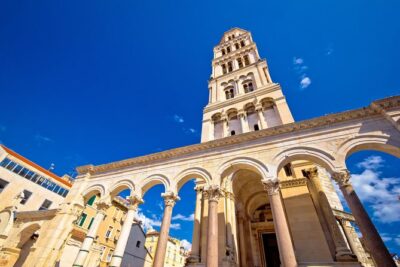


Private Boat Tour by local expert – Create Your Itinerary
Read our review →
Split airport to Split Private transfer to 8 pax (Door to Door any location)
Read our review →Browse the lists this tour appears in