
Review · DIOCLETIAN PALACE TOURS
History & Cultural Walking Tour of Split and Diocletian’s Palace
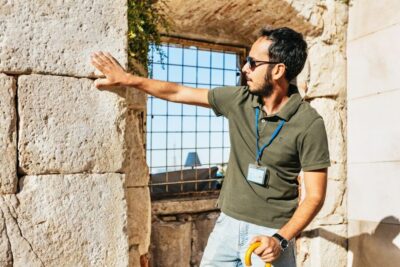
Diocletian’s Palace is not a sealed-off ruin. It is the heart of Split, threaded with lanes, squares, shops, and everyday city life. This small-group walking tour gives you a useful way into that layered setting, with a guide to explain how the palace became part of the city around it.
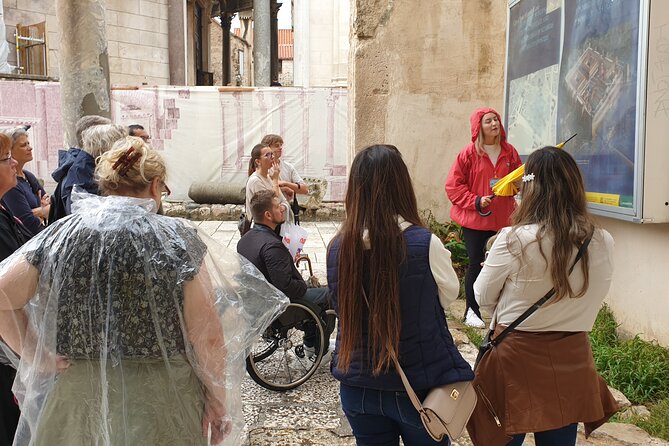
I like two things in particular: the route links major sights with cultural details, including the story of the Croatian language and Split’s Jewish community, and the group is capped at 15 people. Some guides also add traditional klapa singing, a lively local touch.
The main consideration is the pace and footing. You’ll spend most of the 90 minutes on foot, and the tour is not recommended if high steps are difficult for you. The palace substructures museum is not included, so plan a separate visit if you want to see it.
- The Peristyle anchors the walk: Start in the palace’s central square, a natural point of orientation for the surrounding lanes.
- The route pairs Roman remains with city life: You’ll move from palace rooms and gates to the Riva promenade and Fruit’s Square.
- Croatian culture gets real attention: Hear about Gregory of Nin, writer Marko Marulić, and Split’s Jewish history.
- Small groups keep the guide close: The maximum group size is 15, with individual tours sometimes much smaller.
- Expect a brisk, compact introduction: The scheduled walk is about 90 minutes, though the pace and length can vary.
- Budget for the museum separately: The palace substructures museum is not part of the tour.
A good first map of Split’s old center
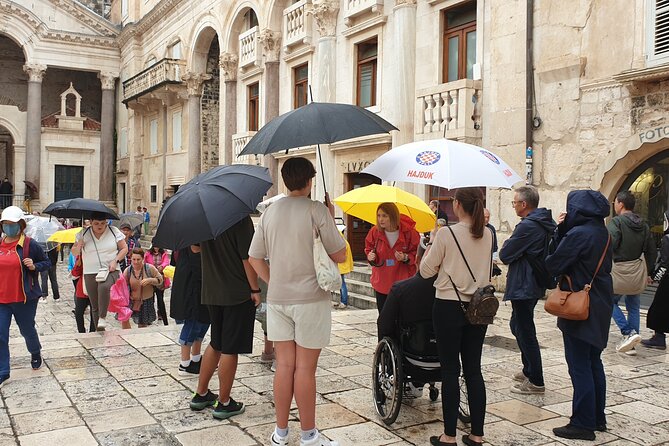
This walk is designed to help you read the city, not just tick off monuments. Diocletian’s Palace is the main subject, but the route also shows how Split’s public spaces and cultural landmarks fit around it. That makes the tour a sensible first activity if you have only a short stay or want context before exploring on your own.
The listed price is $22.98 per person, with group discounts available. For that, you get an English-speaking guide and a focused route through several central sights. Since the key stops are outdoors or part of the historic center, the value is less about paid entry and more about having someone explain what you’re seeing while you’re standing in it.
The itinerary is scheduled for about 90 minutes. Its stop timings add up to roughly 75 minutes, leaving room for walking between places and for the guide to connect the stories. One small-group outing has lasted close to three hours, so don’t treat the duration as a strict promise. If you have a timed commitment immediately afterward, leave a buffer.
The Peristyle: the palace’s central stage
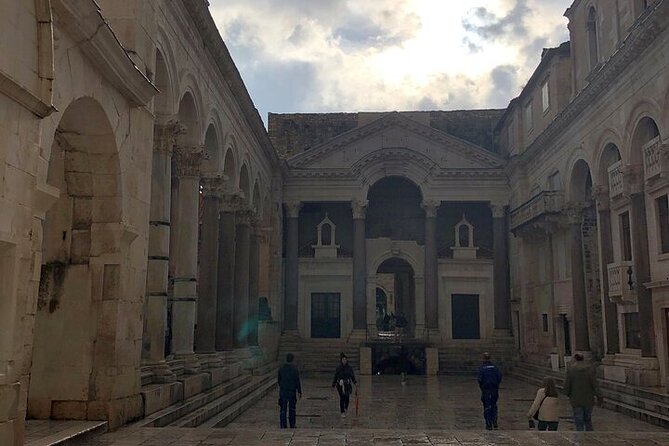
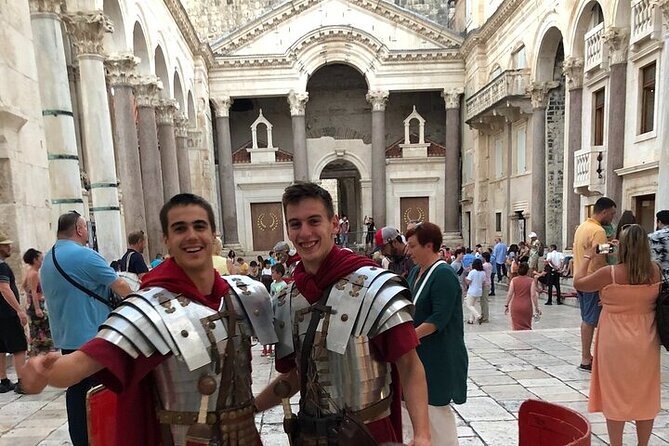
The walk begins at the Peristyle, the central square of Diocletian’s Palace. It is a practical starting point as well as a striking one: from here, you can reach many of the palace’s other locations, and the guide can use the square to set the scene for the route.
Allow about 15 minutes here. That gives you time to take in the space and understand its place in the palace plan before heading into the smaller stops. The Peristyle is also a useful reference point for later independent wandering. If you return after the tour, you’ll have a better sense of which lanes lead where.
This is a good place to ask questions early. A guide who explains the basic layout clearly can make the rest of the walk easier to follow, especially if ancient architecture is not usually your thing. You do not need to arrive with a history degree. The tour is meant to make the place more legible, not bury you in dates.
More walking tours in Split:
- Split: Old Town and Diocletian Palace Walking Tour
★ 4.9 · 4,727 reviews - Walking Tour of Split and Diocletian’s Palace
★ 5.0 · 2,588 reviews - Krka Waterfalls tour with Trogir Walking tour and Krka panoramic boat cruise
★ 5.0 · 1,659 reviews
The Vestibule: a short stop with a local sound
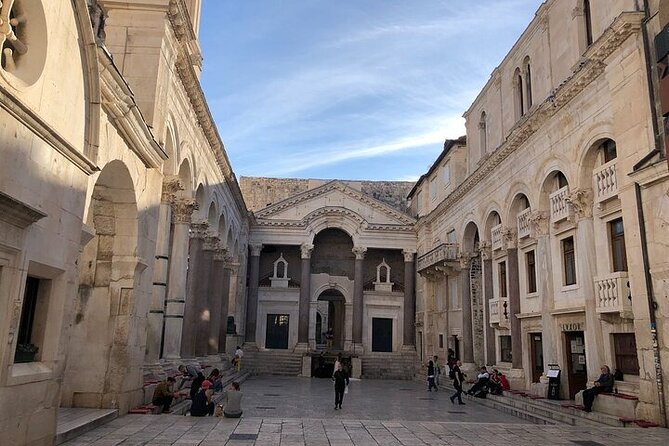
The Vestibule, once part of Diocletian’s palace, gets about five minutes. The stop is brief, but it adds another architectural piece to the story of how the palace was arranged and used.
You may also hear traditional Dalmatian singing. Some tours have included a klapa performance, an especially memorable way to connect the historic setting with a living local tradition. It is not listed as a guaranteed performance, so think of it as a possible bonus rather than a scheduled concert.
A five-minute stop can feel quick if you want to linger over architecture, but the short format helps the walk cover several parts of the center. If the singing happens during your tour, enjoy it in the moment. If not, you’ll still have the guide’s explanation of the space.
The substructures: under the palace, but not the museum
Next comes the substructures of Diocletian’s Palace, with about ten minutes devoted to their construction and changing function over time. This stop gives you a different perspective from the open squares and lanes above: you’ll hear about the lower spaces and how they fit into the palace’s design.
Keep one distinction clear. The tour passes through the substructures, but it does not include the museum section. You can visit that separately afterward, which is useful if you want to spend longer looking around rather than keeping to the group’s pace.
If you’re particularly interested in Roman building methods, this is a stop to listen closely at. Ten minutes is enough for an introduction, not a thorough museum visit. The guide’s explanation will help you decide whether to return and explore the museum on your own.
The Golden Gate and Gregory of Nin
The Golden Gate was the palace’s main entrance and receives about ten minutes on the route. Here, the guide explains the gate and introduces the nearby statue of Gregory of Nin, along with his significance to Croatian history and language.
This is one of the tour’s strongest cultural turns. Instead of treating the gate as an impressive old entrance and moving on, the guide connects the site to a person whose importance reaches beyond the palace itself. That shift from stonework to language and identity gives the walk a broader frame.
The stop also helps you understand that the tour is not only about Roman remains. Split’s story is presented through several periods and cultural layers, with the palace as the starting point rather than the whole subject.
More Diocletian Palace tours in Split:
- Split & Diocletian’s Palace Walking Tour
★ 5.0 · 1,125 reviews - Split: Diocletian Palace & Old Town Guided Walking Tour
★ 4.7 · 882 reviews - Split: Game of Thrones Tour with Diocletian’s Palace Cellar
★ 4.8 · 545 reviews - Diocletian’s Palace and Old Town SMALL GROUP Walking Tour
★ 5.0 · 502 reviews
Riva Harbor: the city’s public face
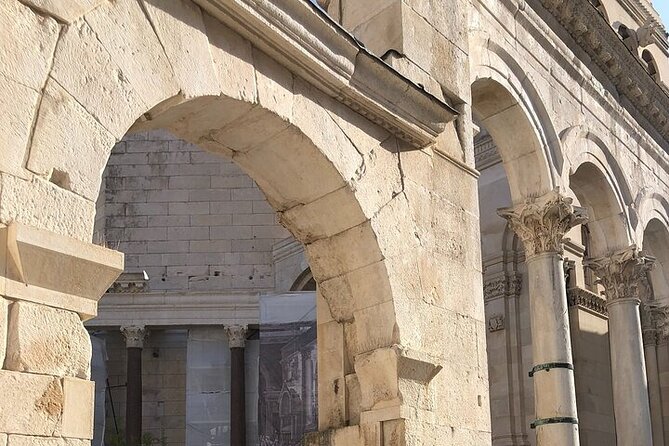
The walk spends about 15 minutes at Riva Harbor, Split’s promenade. You’ll see a bronze model of Diocletian’s Palace and hear about the history of the Riva, a useful pause after the tighter spaces of the old center.
The model is a practical aid: it gives you a view of the palace as a larger plan, rather than a maze of individual alleys. It can help you picture the scale of the complex and connect the route’s stops. The promenade also offers a change of pace, with more open space than the palace lanes.
If you’re planning to explore afterward, pay attention to how the guide describes the Riva’s place in the city. It gives you another point of orientation and a sense of how Split’s historic center meets the harbor. The walk does not promise a meal or a harbor cruise, so treat this as a guided look at the promenade, not a dining stop.
Fruit’s Square: a Venetian citadel and Croatian letters
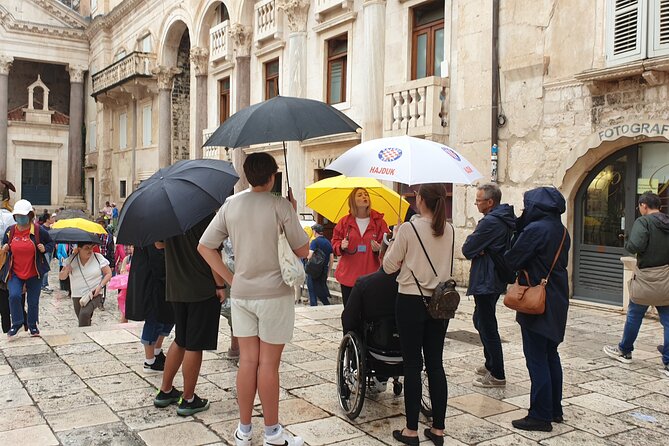
Fruit’s Square, also called Trg Brace Radic, gets about ten minutes. The guide discusses a 15th-century Venetian citadel and Marko Marulić, often called the father of Croatian literature.
This stop adds a different historical thread to the tour. The focus moves from the Roman palace to Venetian influence and Croatian writing, helping you see the old center as a place shaped over centuries rather than preserved in one era. For anyone curious about language and national culture, Marulić’s story is a useful counterpoint to the ancient sites.
The square is also a good moment to ask the guide for ideas on what to explore next. Guides such as Ivana have offered suggestions for further sightseeing, and the tour’s compact route gives you a helpful base for making your own plans.
The Split Synagogue and the city’s Jewish past
The route passes by Split Synagogue, dating to the 16th century, and spends about ten minutes on the history of the Jewish community in the city. The synagogue is not included as an admission stop, so expect to hear about it from the outside rather than enter as part of the tour.
I value this inclusion because it broadens the walk beyond imperial history and grand architecture. A short stop cannot cover the full story of a community, but it can point out a part of Split’s past that you might otherwise miss while following the busiest sights.
If you want to learn more after the tour, note the location and ask the guide what is open to visit independently. The provided tour information does not promise interior access, so do not plan on entering during the group walk.
Small group, personal guide, and a little flexibility
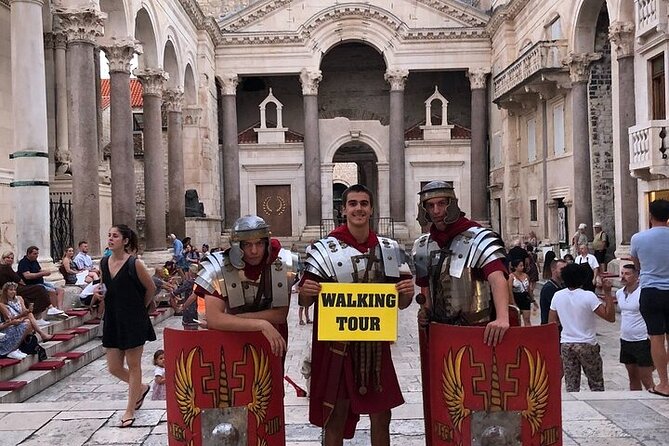
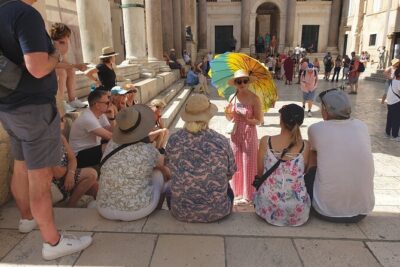
The maximum group size is 15, which is small enough for the guide to address questions and keep the group together through narrow parts of the center. Some departures may be much smaller. One 9 a.m. outing had only three people and ran for nearly three hours, showing how the experience can become more conversational when the group is tiny.
Guides who have led this tour include Darko, Ivana, and Ante, also known as Anthony in American usage. Their approach can shape the experience: accounts of the tour describe humor, clear explanations, questions for the group, and extra historical detail. You cannot choose or count on a particular guide from the information provided, but the emphasis is on an educated guide with strong knowledge of the palace and surrounding locations.
An earlier start can be helpful if your schedule allows it. One morning group appreciated seeing the sights with fewer crowds, though the tour information does not guarantee a specific crowd level or departure time. Check the time offered for your date before booking.
Is $22.98 good value?
At $22.98, the tour is an affordable way to get a guided introduction to several central landmarks. The stops themselves do not generally require an admission ticket, but you are paying for the guide’s explanations, a planned route, and the chance to ask questions as you go. For a first visit, that context can be more useful than simply walking past the same places with a map.
The value is strongest if you enjoy history or want a quick orientation before exploring independently. It is also a reasonable fit if your time in Split is limited and you want to connect the Peristyle, Golden Gate, Riva, and nearby squares in one outing.
The price does not include gratuities, and the substructures museum is not part of the walk. If you want a long, in-depth visit to every palace space, this tour is only a starting point. If you want a compact overview with a local guide, the price is easier to justify.
Practical points before you book
The meeting point is Peristil ulica, at Peristil in Split, and the tour ends back at the same meeting point. A mobile ticket is available, and the activity is offered in English. It is near public transportation, and most people can participate, but the walk is not recommended for anyone who has trouble with high steps.
Confirmation is provided at booking. Free cancellation is available until 24 hours before the start time; changes made within 24 hours are not accepted, and late cancellations are not refunded. The tour also requires a minimum number of participants. If that minimum is not met and the tour is canceled, you will be offered another date or experience, or a full refund.
The tour is booked, on average, about 80 days ahead. That figure does not mean every date sells out that early, but if you have a fixed travel schedule or want a particular departure, booking ahead is sensible.
Should you book this Split walking tour?
Book it if you want a friendly, history-led introduction to Split’s central sights, especially if Diocletian’s Palace is the reason you came. The small-group cap, English-language guidance, and mix of Roman, Venetian, literary, and Jewish history make the route more useful than a simple lap around the palace.
Skip it if you need step-free access, want to visit the substructures museum as part of a guided tour, or prefer to spend a long time at each individual monument. For most first-time visitors who can manage the walking, this is a practical and fairly priced way to understand what they are looking at before setting off on their own.
FAQ
How long is the tour?
The tour lasts about 1 hour and 30 minutes. The actual time can vary, and one small-group outing lasted nearly three hours.
What is the tour price?
The listed price is $22.98 per person. Group discounts are available.
What language is the tour offered in?
The tour is offered in English.
How many people can join the group?
The tour has a maximum of 15 participants. Some departures may be smaller.
Where does the tour begin and end?
It starts at Peristil ulica, at the Peristyle in Split, and ends back at the same meeting point.
Is admission to the palace substructures museum included?
No. The tour visits the substructures but does not include the museum section. You can visit the museum afterward.
Is the Split Synagogue included as an interior visit?
No. The group passes by the 16th-century synagogue and hears about Split’s Jewish history. Admission is not included.
Is the tour suitable for someone who has trouble with high steps?
The tour is not recommended for people who have issues with high steps.
More history tours in Split
- Walking Tour of Split with a ‘Magister’ of History
★ 5.0 · 1,122 reviews - Split Walking Tour with Professor of History
★ 5.0 · 926 reviews - Split: History and Heritage Walking Tour
★ 4.9 · 650 reviews - Split History and Gastro Small-Group Tour with Food and Drinks
★ 5.0 · 375 reviews
Just reviewed in Split
- Split City Walking Tour★ 5.0 · 5 reviews
- Split City Electric Bike Tour★ 5.0 · 68 reviews
- Split Cooking Class – Afternoon Edition Shared Activity★ 5.0 · 8 reviews
- Marjan Park & Split City Bike Tour★ 5.0 · 51 reviews
- Split: Blue Lagoon & 3 Islands Speedboat Tour – Small group★ 4.5 · 46 reviews
- Split Quest Experience: Discover the City★ 3.5 · 5 reviews
- Split: Blue Lagoon, Hvar, Brač, 6 Islands Boat Tour – Small Group★ 5.0 · 57 reviews
- Private transfer Split Airport to Split★ 5.0 · 28 reviews
Diocletian Palace Tours, compared.
Walking Tour of Split and Diocletian’s Palace
Read our review →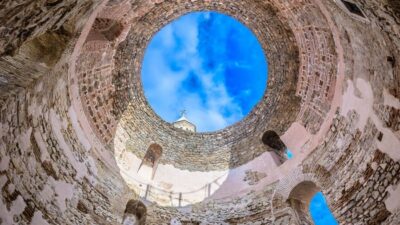
Game of Thrones Tour with Diocletian’s Palace Cellar
Read our review →
Game of Thrones Small group Tour with Diocletian’s Cellar
Read our review →Browse the lists this tour appears in