
Review · SPLIT HISTORY TOURS
Private History tour – small group
Split’s old town is a Roman palace that grew into a living city. This private walk connects its gates, courtyards, temples, and squares, giving you a useful introduction to a place where ancient stonework is part of the everyday street plan.
I like two things here: Ivan’s history background gives the tour a strong foundation, and a private group of up to 10 can stop to ask questions instead of trying to keep pace with a crowd. The route also reaches beyond the palace walls to the Riva and medieval squares, so you get a feel for more than one period of Split’s past.
One consideration: this is a walking introduction, not an inside visit to every monument. You will see the Cathedral of Saint Domnius from outside, and admission to it and the Temple of Jupiter is not included. The advertised duration varies, so leave room in your schedule.
- A private walk for your group: The $238.28 price covers up to 10 people, not each person individually.
- History with context: Guide Ivan Fistanić has a master’s degree in history.
- Roman and medieval Split: See palace spaces alongside squares and buildings from later periods.
- Room for questions: The private format suits people who want to ask about the sights as they go.
- A central starting point: Meet at Ul. kralja Tomislava 15, with the tour ending back there.
- Allow up to two hours: The experience is listed at approximately 1 hour 30 minutes to 2 hours.
A city tour built around Diocletian’s Palace
This is a compact orientation walk through central Split, with Diocletian’s Palace as its main subject. The palace began as the Roman emperor’s residence and became the framework for the old town. Today, its gates and grand public spaces sit alongside later churches, homes, shops, and squares. A guide helps you read those layers rather than seeing a collection of old stones without a story.
Ivan Fistanić leads the tour and has a master’s degree in history. That background matters on a walk like this: the route moves quickly across Roman, Christian, and medieval landmarks, and the explanations can connect them. The tour’s appeal is not just the number of stops, but the chance to ask how a Roman structure changed function as Split changed around it.
The private format makes the experience more personal than a large group walk. Your party can ask questions and follow up on points that interest you. It is a good fit if you want a clear introduction before exploring the old town on your own, or if you prefer a guide who can respond to your group rather than address a crowd.
Starting near the palace and the Golden Gate
The meeting point is Ul. kralja Tomislava 15, a central address in Split. The tour ends back at the same point, which makes it easy to continue your day nearby. The route information also describes time on the Riva, the city’s waterfront promenade, so confirm the precise meeting instructions when you book rather than assuming the first sight listed is the first place you will visit.
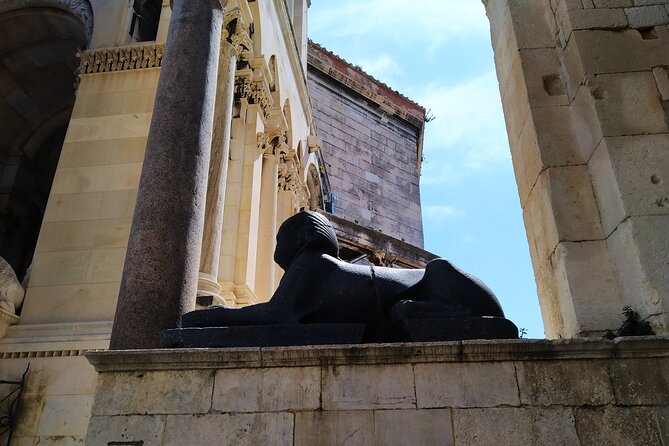
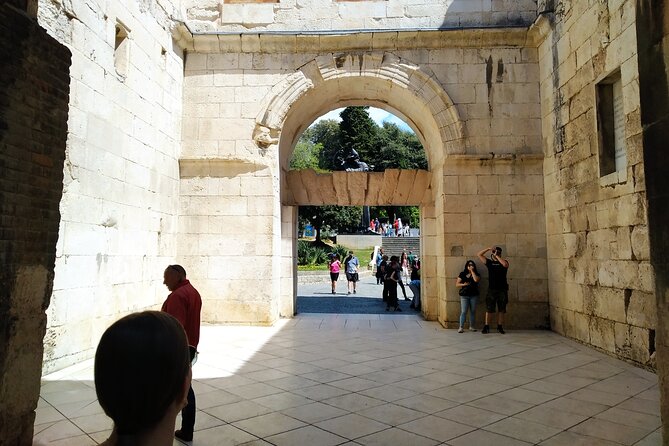
The Golden Gate is one of four main Roman entrances to Diocletian’s Palace and faces north, toward Salona, the capital of the Roman province of Dalmatia and Diocletian’s birthplace. It is also opposite the statue of Gregory of Nin, making this a useful place to connect the palace’s original plan with a later Split landmark.
You have about 15 minutes at the gate. That is enough for an introduction and a closer look at the setting, though not a long architectural study. The gate is free to see, and its position helps you understand that this was not an isolated ruin: it was an entrance into the emperor’s complex, now woven into the city.
More history tours in Split:
- Walking Tour of Split with a ‘Magister’ of History
★ 5.0 · 1,122 reviews - Split Walking Tour with Professor of History
★ 5.0 · 926 reviews - Split: History and Heritage Walking Tour
★ 4.9 · 650 reviews
From the Riva to the palace’s central court
The Riva is Split’s main promenade and a meeting place for locals and visitors. Here, Ivan explains how it developed over time and why it became central to city life. You can also see the palace’s southern wall from the waterfront, a helpful view before turning into its interior.
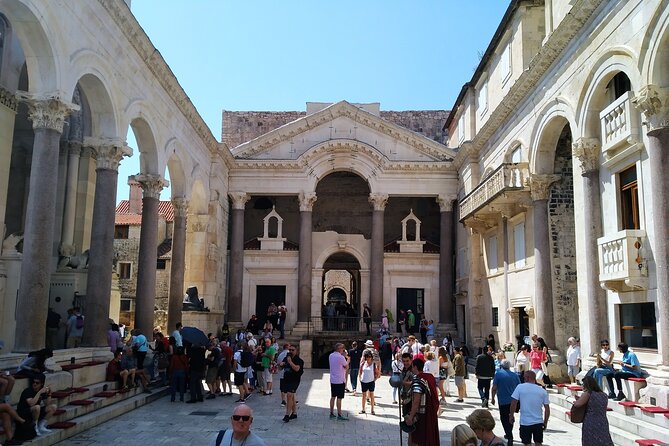
The tour then takes you toward the palace cellars, where the guide discusses their uses through history, before reaching the Peristyle. The Peristyle was the palace’s central open space, framed by monumental arcades and oriented toward the imperial loggia. It is one of the clearest places to grasp the scale and form of the Roman complex.
The Peristyle is also a good spot to hear about the changes brought by the spread of Christianity. The palace was not frozen in its original purpose; its spaces and buildings shifted as religious and civic life changed. The planned stop is about 15 minutes, so expect a concise explanation with time to look around rather than a long pause.
Seeing the Cathedral of Saint Domnius from outside
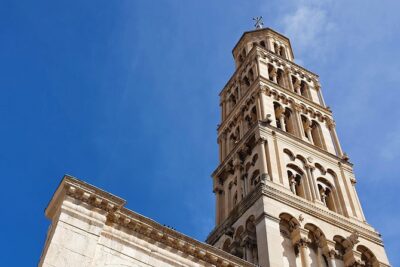
The Cathedral of Saint Domnius is hard to miss from the Peristyle. Its setting makes the city’s layered history especially plain: a Roman structure remains in use as a Christian place of worship. The tour focuses on its significant parts and the story behind them.
You will not enter the cathedral on this tour, and admission is not included. If seeing the interior is important to you, plan to visit separately and check the current entry arrangements. The outside explanation still gives you a useful way to understand the building’s place in the palace, but it is not a substitute for going inside.
The stop is listed at about 10 minutes. That short visit makes sense as part of a broad introduction, especially because the cathedral sits directly beside the Peristyle. If you want a slower look at architectural details, allow extra time after the tour.
The Temple of Jupiter and the Vestibule
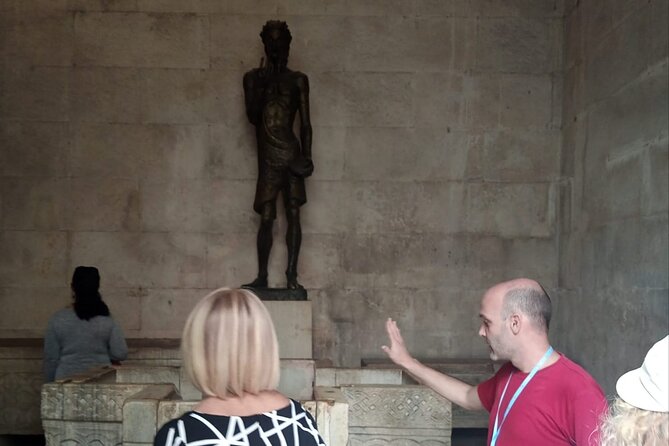
The Temple of Jupiter is another Roman landmark with a later Christian chapter. It was dedicated to Jupiter, the Roman god associated with the sky and thunder and king of the gods, reflecting the connection Diocletian made between himself and the divine. In the Middle Ages, the temple became a baptistery dedicated to Saint John the Baptist.
The visit is listed at about 10 minutes, and admission is not included. The information for the tour does not specify whether the group enters, so do not assume an interior visit is part of the experience. The key value is the explanation of how a pagan temple acquired a new religious role.
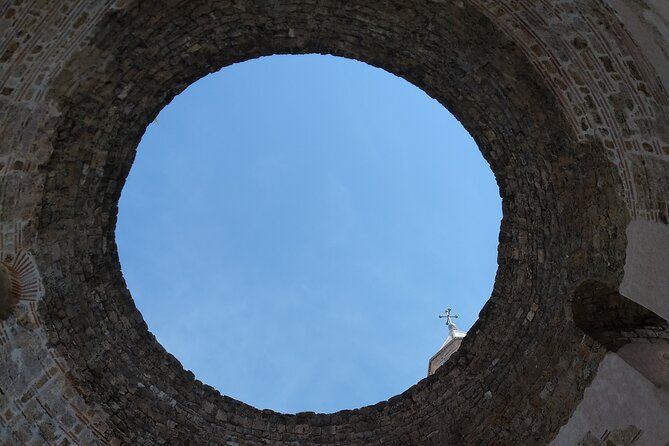
From there, the Vestibule gives you a look at the pre-entrance to Diocletian’s private chambers. Its decoration reflected the importance of the space, and Ivan explains its function and appearance. The group also looks toward the Triclinium. This stop offers a glimpse of the more private side of palace life, set against the public grandeur of the Peristyle.
More private tours in Split:
- SPLIT-PRIVATE Walking Tour of Diocletian’s Palace & Old Town
★ 5.0 · 467 reviews - Private Krka Waterfalls tour with 30min Boat Cruse
★ 4.0 · 458 reviews - Split by Private Electric Rickshaw – Palace & Hidden Gems
★ 5.0 · 412 reviews - Private Blue cave, Mamma Mia and Hvar, 5 islands tour from Split
★ 5.0 · 387 reviews
Fruit’s Square and Pjaca beyond the Roman walls
Fruit’s Square, also called Trg Braće Radić, sits just outside the palace and is among the old town’s most picturesque spaces. A 15th-century Venetian fort remains a strong feature of the square. The guide also discusses its central monument and other surrounding sights, giving you a sense of how Split continued to develop after the Roman period.
The planned stop is 20 minutes, the longest listed. That extra time gives you a chance to take in the square and its varied architectural details without treating it as a quick pass-through. It also makes clear that the tour is not confined to the palace interior: medieval and Venetian-era Split are part of the story too.
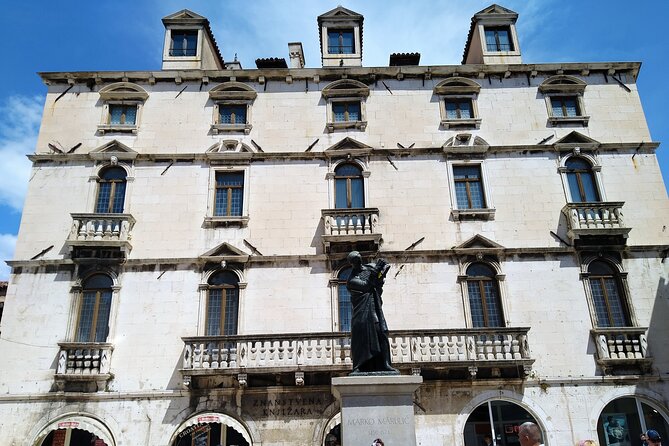
Pjaca, the main square since medieval times, lies outside the palace’s western wall. The old Town Hall, dating to the 14th century, is one of the structures to look for. The square’s changing character and variety make it a natural contrast with the more formal Roman spaces nearby. The stop is about 10 minutes, enough for an introduction and a closer look.
Finishing at Gregory of Nin
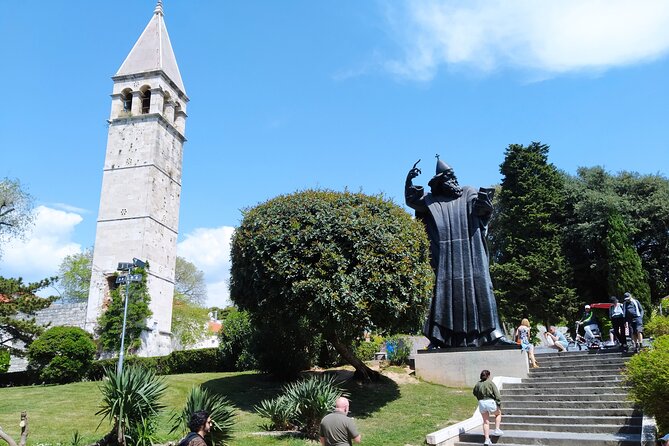
The tour includes the statue of Gregory of Nin, a recognizable Split landmark and a work by Croatian sculptor Ivan Meštrović. You will hear about Gregory, the monument, and its sculptor. The statue’s toe is traditionally rubbed for good luck, a light-hearted ritual that gives the stop an easy ending after a lot of history.
This is also a chance to connect the statue back to the Golden Gate, which stands opposite it. The route brings together two very different kinds of landmark: a Roman entrance and a modern monument to a medieval church figure. You get a quick visual reminder that Split’s history is not one era neatly replacing another.
How the price and timing work
The listed price is $238.28 per group of up to 10 people. For a full group, that works out to about $23.83 per person. With fewer people, the per-person cost rises, but you still pay for the private experience rather than joining strangers. That can be worthwhile if you value being able to ask questions and keep the walk focused on your interests.
The tour lasts approximately 1 hour 30 minutes to 2 hours. The individual stop estimates add up to about 110 minutes, so the upper end of the time range is sensible to plan around. The walk covers several closely connected parts of the historic center, but the timing leaves little room for a long independent visit inside a monument.
A mobile ticket is provided, and the activity is private to your group. Most travelers can participate, and the meeting point is near public transportation. No additional transport is described as part of the experience, so treat this as a walking tour rather than a ride between sights.
Who should book this Split history walk
I would choose this tour if you want a guided introduction to Split’s central sights and prefer a small, private setting. It suits first-time visitors who want help making sense of the palace’s layout, as well as history-minded visitors who like asking questions as they go. The route’s mix of Roman, Christian, medieval, and Venetian landmarks gives you a broad overview in a short visit.
It is less suited to anyone looking for lengthy interior visits or a slow, specialist examination of one monument. The cathedral is viewed from outside, and admission to it and the Temple of Jupiter is not included. If you want to enter particular buildings, use the walk as an orientation and make separate time for those visits.
The tour has a 5 out of 5 rating based on six ratings, a positive signal but a small sample. The strongest praise centers on Ivan’s detailed explanations and his willingness to answer questions. That matches the private format well: you get a guide with a history background and space to engage with the subject, rather than just a quick roll call of landmarks.
Book it if you want an efficient, question-friendly introduction to Split’s old town. The price makes the most sense for a group sharing the cost, and the tour is particularly useful early in a stay, when the palace’s streets and squares can still feel like a maze. If your main goal is to go inside several monuments, plan extra visits beyond the walk.
FAQ
How long does the tour take?
It lasts approximately 1 hour 30 minutes to 2 hours. The listed stop times add up to about 110 minutes, so allow for the longer end of the range.
Where does the tour start and end?
It starts at Ul. kralja Tomislava 15 in Split and ends back at the meeting point.
Is this a private tour?
Yes. Only your group participates, with a maximum group size of 10.
Who is the guide?
The experience is provided by Ivan Fistanić, who has a master’s degree in history.
Are entrance tickets included?
The Golden Gate, Peristyle, Vestibule, Riva, squares, and Gregory of Nin statue are listed as free stops. Admission to the Cathedral of Saint Domnius and Temple of Jupiter is not included, and the cathedral is not entered during the tour.
Can I cancel for a refund?
You can cancel at least 24 hours before the start time for a full refund. Cancellations or changes made less than 24 hours beforehand are not accepted for a refund. If poor weather cancels the tour, you will be offered another date or a full refund.
Just reviewed in Split
- Split City Walking Tour★ 5.0 · 5 reviews
- Split City Electric Bike Tour★ 5.0 · 68 reviews
- Split Cooking Class – Afternoon Edition Shared Activity★ 5.0 · 8 reviews
- Marjan Park & Split City Bike Tour★ 5.0 · 51 reviews
- Split: Blue Lagoon & 3 Islands Speedboat Tour – Small group★ 4.5 · 46 reviews
- Split Quest Experience: Discover the City★ 3.5 · 5 reviews
- Split: Blue Lagoon, Hvar, Brač, 6 Islands Boat Tour – Small Group★ 5.0 · 57 reviews
- Private transfer Split Airport to Split★ 5.0 · 28 reviews
Split History Tours, compared.
Walking Tour of Split with a ‘Magister’ of History
Read our review →
Split History and Gastro Small-Group Tour with Food and Drinks
Read our review →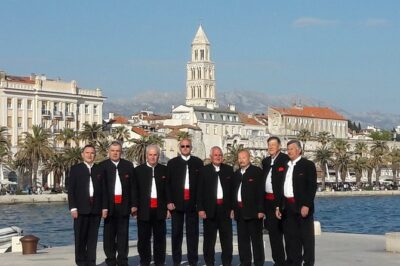
PREMIUM Emperor’s Walking Tour for History Lovers + Museum
Read our review →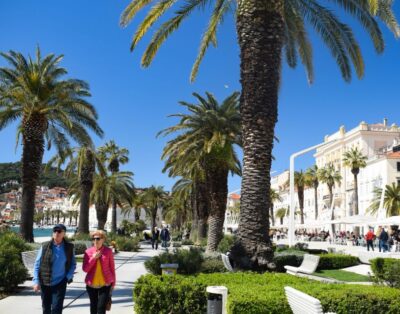
Local History and Culture 90-Minute Walking Tour
Read our review →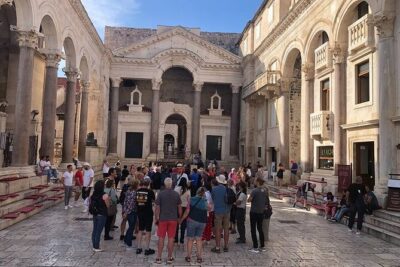

Historical & Gastro Treasures Tour with Green Market
Read our review →Browse the lists this tour appears in