
Review · SPLIT HISTORY TOURS
Split: History Walking Tour of the Old Town
Split’s old town is not just built beside a Roman palace. It grew inside one. This 90-minute walk takes you from the Golden Gate through Diocletian’s Palace and its atmospheric cellars, then out to the seafront Riva.
I like two things in particular: the guide connects big Roman landmarks to memorable stories, and the route ends with useful advice on local food, beaches, and islands. The Game of Thrones cellars add a fun pop-culture stop, but the real reward is seeing how ancient stone still shapes daily life in Split.
One consideration: 90 minutes is a brisk introduction, not enough time to linger at every stop. The old town can also be crowded, so come ready to walk, listen, and keep moving.
Key points to know before you book
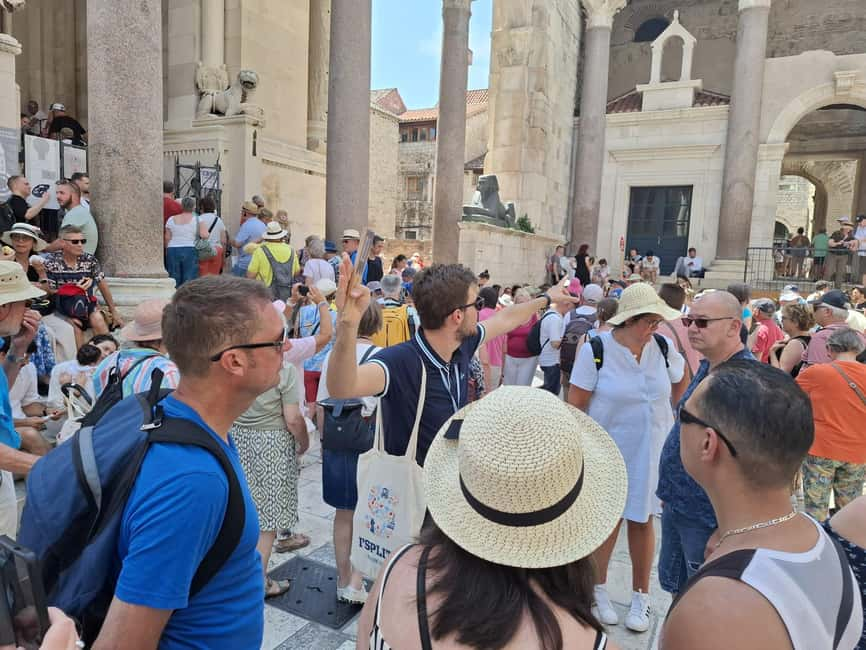
- The palace is the setting, not just a stop: You walk through Diocletian’s Palace, whose streets and squares form the core of Split’s old town.
- The route mixes famous sights and smaller squares: Expect the Golden Gate, Peristyle, Temple of Jupiter, Vestibule, People’s Square, Fruit Square, and Riva.
- The cellars link Roman history with TV lore: You’ll see spaces used as Daenerys’s dragon lair and as a setting for battles in Game of Thrones.
- Stories make the short walk lively: Guides use questions, riddles, jokes, and visual aids to explain the city’s past.
- Practical local advice is part of the tour: You can ask about Dalmatian food, beaches, ice cream, and which islands to visit.
- The format can vary: Tours are available in English or Spanish, and private groups and optional hotel or cruise-ship pickup are offered.
Walking through a palace that became a city
Split’s old town rewards a guide because the Roman plan is not tucked away behind museum doors. It is the framework of the place. You pass through palace gates, cross courtyards, and walk along streets where the city’s later life has filled in and adapted the ancient structure.
The palace was built for Emperor Diocletian, who retired here in the early fourth century. Today, it is part of a city protected by UNESCO, but this is not a tour of a silent ruin. Shops, homes, cafés, and public squares occupy the old walls. Your guide helps you read the layers, so a doorway or a change in stonework becomes more than a photo stop.
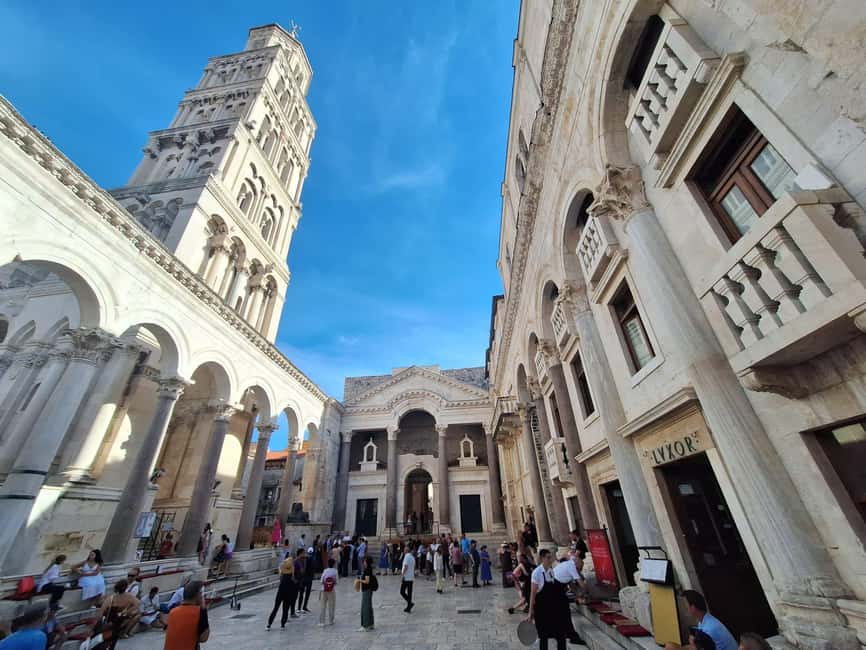
The walk starts at the Golden Gate, though the exact meeting point depends on the option you book. From there, the route takes in Đardin Park, the Peristyle, the Mausoleum, the Temple of Jupiter, the Vestibule, People’s Square, Fruit Square, the palace cellars, and the Riva. The stops have different rhythms: some are brief explanations in a busy square, while others give you time to take in the setting.
I’d treat this as a first orientation rather than a substitute for exploring on your own. Once the walk ends, you’ll have a better sense of where the palace’s main spaces sit and which places deserve a second look.
More walking tours in Split:
- Split: Old Town and Diocletian Palace Walking Tour
★ 4.9 · 4,727 reviews - Walking Tour of Split and Diocletian’s Palace
★ 5.0 · 2,588 reviews - Krka Waterfalls tour with Trogir Walking tour and Krka panoramic boat cruise
★ 5.0 · 1,659 reviews
Golden Gate and Đardin Park: the city’s Roman entrance
The Golden Gate is a fitting starting point. It was one of the main entrances to Diocletian’s palace, and its scale gives you an immediate feel for the city’s Roman foundations. Your guide explains what you’re looking at before leading you into the nearby Đardin Park area.
This is where the tour’s storytelling style matters. Instead of only naming dates and rulers, a guide can use questions and small puzzles to draw you into the past. One story invites you to imagine answering the Sphinx’s riddle, a playful way to set up the palace’s Egyptian details and the sphinx that appears later at Jupiter’s Temple.
The entrance and park are public spaces, so crowds may affect how long you can comfortably pause. A guide who knows the route can help keep the group moving and make room to hear the explanation. Still, if you want a quiet, close-up look at every carving, plan to return at a less busy time.
Peristyle and Mausoleum: the palace’s grand center
The Peristyle is one of the most striking stops on the walk. This open courtyard was the palace’s ceremonial heart, framed by stone columns and monumental architecture. Your guide spends about 15 minutes here, enough to understand its role and take in the scene without turning the tour into a long architectural lecture.
The Mausoleum is part of this same central setting. Diocletian, known as a persecutor of Christians, was buried here. The contrast between his history and the later Christian use of the building gives the guide a natural way to explain how power and religion shifted over the centuries.
You may also hear one of the tour’s more unusual stories about Diocletian: why he supposedly vomited after dinner. That kind of detail keeps the history human and slightly irreverent. It is a useful change of pace from dates and building names, though the exact explanation is best heard from your guide on the day.
The tour also points out Split’s cathedral and bell tower, described as the oldest cathedral in the world. The claim is striking, and the building’s long life is part of what makes this area so fascinating. You may not have time to explore the interior or climb the tower during the walk, so ask your guide what is practical to visit afterward.
Jupiter’s Temple and the headless sphinx
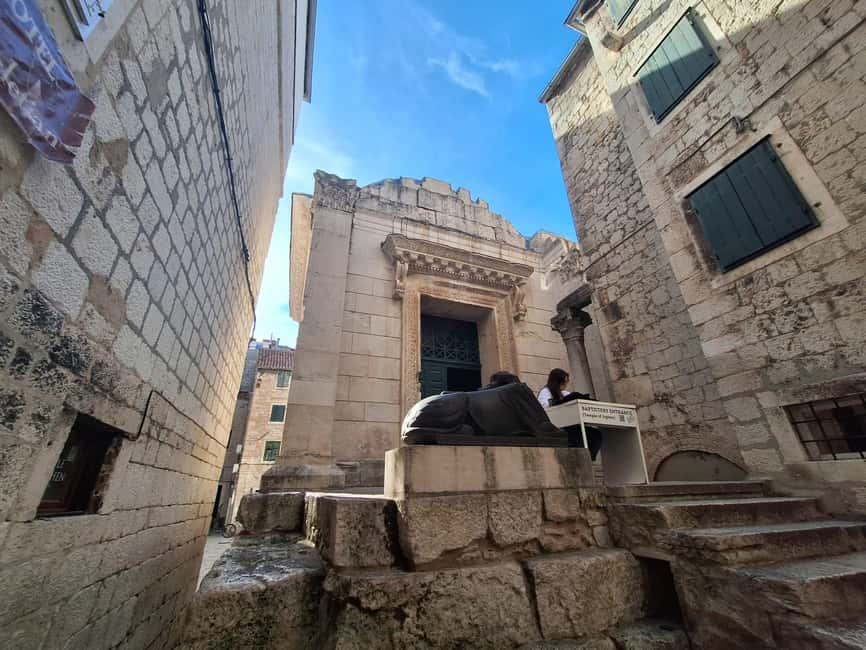
The Temple of Jupiter is a compact stop, with about five minutes set aside for the guide’s explanation. Its small scale makes the details easy to miss if you are moving quickly, so listen for the story of the headless sphinx guarding the entrance. It’s an unusual sight, and the explanation gives you a reason to look closely.
This is also where the tour’s riddle-based approach can pay off. The sphinx is not simply an Egyptian decoration dropped into a Roman palace; it opens a window onto Diocletian’s taste for Egyptian art and the symbols he brought into his home. Your guide can make that connection more memorable than a quick glance and a photograph.
Because this stop is short, it helps to arrive curious. If the temple catches your eye, note its location and return after the tour. The walk is designed to cover several landmarks in 90 minutes, so it cannot give every site the same amount of attention.
More history tours in Split:
- Walking Tour of Split with a ‘Magister’ of History
★ 5.0 · 1,122 reviews - Split Walking Tour with Professor of History
★ 5.0 · 926 reviews - Split: History and Heritage Walking Tour
★ 4.9 · 650 reviews - Split History and Gastro Small-Group Tour with Food and Drinks
★ 5.0 · 375 reviews
The Vestibule and the palace’s surprising interior
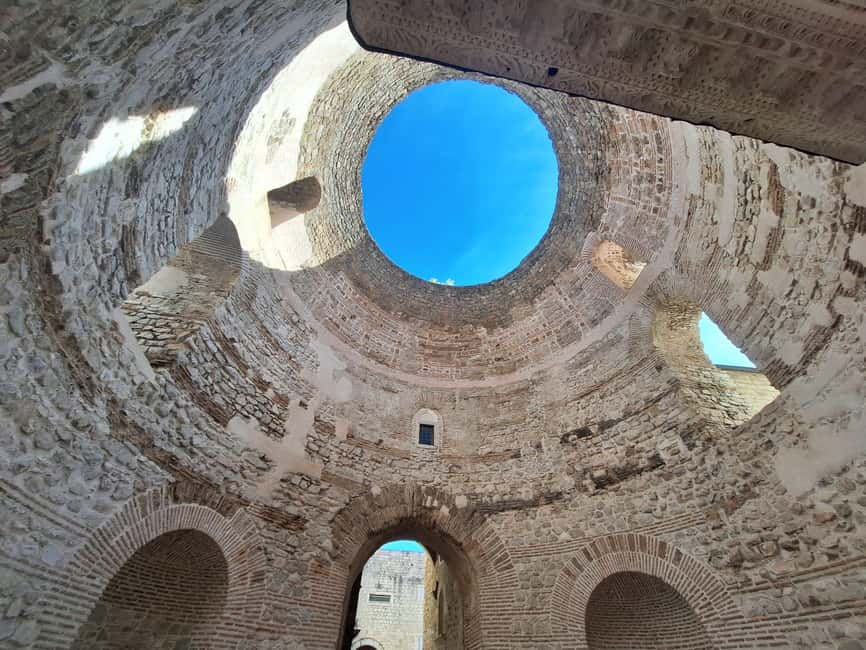
The Vestibule, allotted about 10 minutes, offers a change in atmosphere from the open courtyard. It was an entrance space within the palace, and its shape and scale help you imagine how visitors once moved through the imperial residence. The guide’s account connects the building’s original purpose with the way the old town has evolved around it.
The tour description calls one passage a human mousetrap, an evocative phrase for the palace’s twists and constrictions. That image helps you picture how people could be guided through controlled entrances and corridors. You’ll hear more about how the palace worked as a residence and a fortified complex, rather than simply walking past a set of old walls.
Some tours use photos, maps, or other visual aids to make the story easier to follow. Maya, for example, has used a folder of images and maps while explaining the city. Your guide may have a different approach, but the central aim is the same: help you understand what is not obvious from the stones alone.
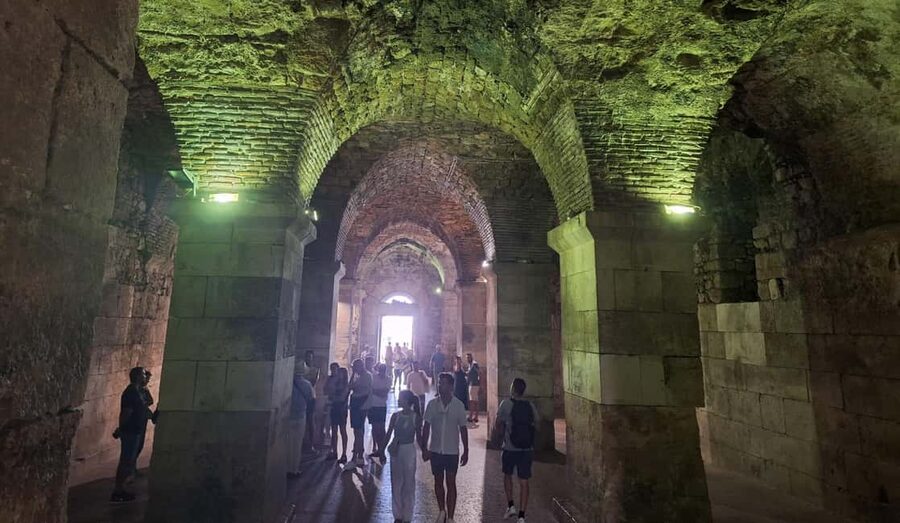
Diocletian’s cellars and the Game of Thrones connection

The cellars are a highlight for many people, both for their Roman history and their screen connection. These underground spaces were used in Game of Thrones as the place where Daenerys’s dragons were chained, and they also appeared as the setting for a fight between the Unsullied and the Sons of the Harpy.
If you know the show, the location gives you a fun moment of recognition. If you don’t, the cellars still make sense as part of the palace’s story. Their stone rooms and passages show how much of the imperial complex survives below the present-day streets. Your guide can help separate the real Roman setting from the fictional events filmed there.
About 15 minutes are set aside for the cellars. That is enough for a guided look, but not necessarily a leisurely exploration of every room. The cooler underground setting can also be a welcome break from the sun. One guide has been praised for taking the group through the cellars during hot weather, although conditions and the exact route can vary.
People’s Square, Fruit Square, and the city beyond Rome
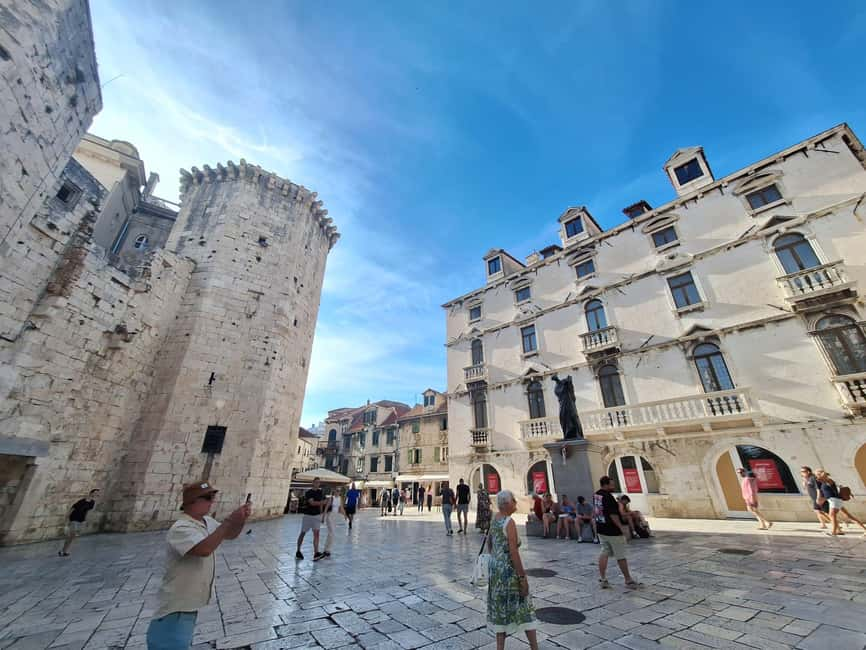
After the palace’s central spaces and cellars, the walk moves into People’s Square, or Pjaca, and Fruit Square, or Voćni trg. These stops show you how Split grew beyond the Roman palace walls and developed its own civic life. They are less about one grand monument and more about reading the city as a collection of eras and public spaces.
A good guide makes this part useful by connecting the old town to present-day Split and Croatia. You may hear about the Venetians and how much they paid for Split, along with broader context about the country and local life. That wider view is especially helpful if you’ve arrived with questions beyond Roman history.
The squares also help orient you for your own wandering later. Pay attention to where the route turns and how the smaller streets connect. Split’s old town is compact, but its dense network of lanes can make it easy to lose your bearings when you first arrive.
Finishing on the Riva, with food and island advice

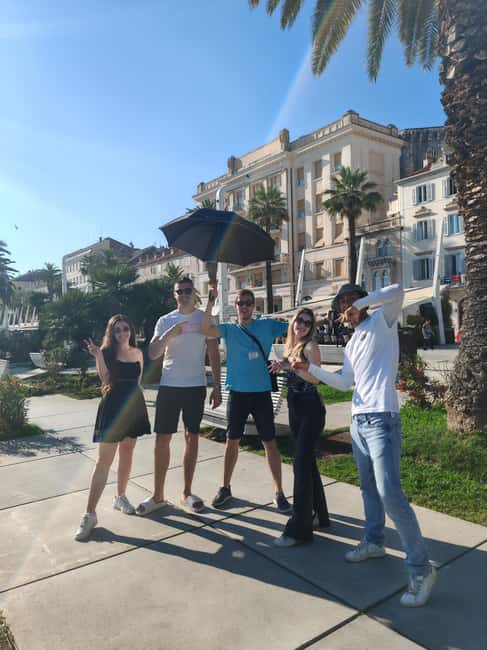
The tour ends at the Riva, Split’s seafront promenade lined with tall palm trees. It is a natural place to stop, look out toward the water, and decide what to do next. The walk may also finish near a model of Split’s historic core, depending on the option and group arrangement.
The practical recommendations are a real part of the value. Your guide can point you toward Dalmatian specialties, explain what locals eat, and suggest where to find them. You can also ask about beaches, ice cream, and which islands might suit the rest of your trip. That local orientation is especially useful when Split is a short stop on a larger Croatian itinerary.
Some guides have also shared tips on local habits and discounts. Ask specific questions while you have the guide’s attention: where to try a regional dish, how to spend an afternoon, or which island might fit your schedule. You will get more from this part if you arrive with a few things you want to know.
What the guide adds to a 90-minute walk
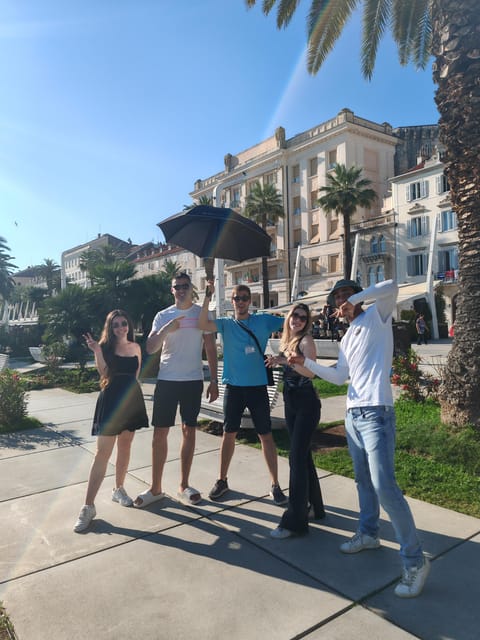
The guide is the main reason to choose this tour over wandering through the palace alone. The buildings are impressive, but many of the best details are not self-explanatory: Diocletian’s reputation, the sphinx, the purpose of the palace spaces, and the way Roman remains became the base for a living city.
The style can be lively rather than formal. Guides have used riddles, jokes, questions, maps, and photos to keep the walk engaging. Names you may encounter include Maya, Nina, and Marko, also written as Marc, but the person leading your tour can vary.
The group size is not fixed in the information available. Some walks have been very small, including one with four people and another that became a solo tour, while private groups are also offered. A small group can make it easier to ask questions, but you should not assume you will have a private experience unless you book that option.
Is $41 fair for the experience?
At $41 per person, this is a solid value if you want an informed introduction to Split rather than a checklist of monuments. The price covers a licensed local guide, a 90-minute history and palace walk, and practical insight into local food and habits. You are paying for explanation and orientation as much as for the route itself.
The tour makes particular sense on your first day in town. It gives you the layout of the palace and old town, then leaves you with ideas for where to eat and what to do next. If you are already well versed in Roman history or prefer to explore at your own pace, you may find the short stops and guided schedule less appealing.
There is a free-cancellation window up to 24 hours before the tour, and you can reserve now and pay later. Those terms offer some flexibility, but check the start time and meeting point for the option you choose. Pickup may also be available: you can provide a hotel street address or indicate that you are arriving by cruise ship.
What to bring and how to get the most from it
Wear comfortable shoes. The route moves through historic streets and palace spaces, and the tour covers several stops in a limited time. A hat, sunscreen, and water are also recommended, particularly if you are walking in warm weather.
Arrive ready to listen and ask questions. The best parts are often the details that connect one place to another, so speak up if you want more about the palace, the city’s present-day life, or local food. If you spot a building you want to revisit, ask where it is before the group moves on.
The walk is available in English and Spanish. If language matters to you, confirm the language and start time when checking availability. You can also choose a private group if you want a more personal format.
Should you book this Split walking tour?
Book it if you want the Roman core of Split explained by a local guide, with a route that covers the major palace sights and finishes with practical advice for the rest of your stay. The mix of Roman history, the cellars, and the Game of Thrones connection gives the walk broad appeal, while the food and island tips make it useful beyond the monuments.
Skip it if you prefer long, unhurried visits at each site or already know the old town well. At 90 minutes, the tour is best as a lively overview. For a first visit, that is often exactly what you need: enough context to make the city’s stones speak, and enough time left afterward to explore on your own.
FAQ
How long is the Split history walking tour?
The tour lasts 90 minutes. It covers several parts of the old town and palace, so expect a brisk walk with short guided stops.
How much does the tour cost?
The listed price is $41 per person. It includes a licensed local guide and the history and palace walking tour.
What languages are available?
The live tour is available in English and Spanish. Check the available start times for the language you want.
Which places does the route visit?
The walk includes the Golden Gate, Đardin Park, Peristyle, Mausoleum, Temple of Jupiter, Vestibule, Diocletian’s cellars, People’s Square, Fruit Square, and the Riva.
Does the tour visit the Game of Thrones cellars?
Yes. You visit the cellars associated with the scenes where Daenerys’s dragons were chained and where the Unsullied fought the Sons of the Harpy.
Is a private tour available?
Yes. A private group is available as an option. The meeting point may differ depending on the option you book.
Is pickup available?
Optional pickup is offered. You can provide the name and street of your hotel or note that you are arriving by cruise ship.
What should I bring?
Bring comfortable shoes, a hat, sunscreen, and water.
Can I cancel the tour for a refund?
You can cancel up to 24 hours in advance for a full refund. You can also reserve now and pay later.
Just reviewed in Split
- Split City Walking Tour★ 5.0 · 5 reviews
- Split City Electric Bike Tour★ 5.0 · 68 reviews
- Split Cooking Class – Afternoon Edition Shared Activity★ 5.0 · 8 reviews
- Marjan Park & Split City Bike Tour★ 5.0 · 51 reviews
- Split: Blue Lagoon & 3 Islands Speedboat Tour – Small group★ 4.5 · 46 reviews
- Split Quest Experience: Discover the City★ 3.5 · 5 reviews
- Split: Blue Lagoon, Hvar, Brač, 6 Islands Boat Tour – Small Group★ 5.0 · 57 reviews
- Private transfer Split Airport to Split★ 5.0 · 28 reviews
Split History Tours, compared.

Walking Tour of Split with a ‘Magister’ of History
Read our review →

Split History and Gastro Small-Group Tour with Food and Drinks
Read our review →
PREMIUM Emperor’s Walking Tour for History Lovers + Museum
Read our review →
Local History and Culture 90-Minute Walking Tour
Read our review →

Historical & Gastro Treasures Tour with Green Market
Read our review →Browse the lists this tour appears in