
Review · SPLIT HISTORY TOURS
Split: Private Walking Tour in the Historical Town Center
Split’s old town is not a Roman ruin set apart from modern life. It grew inside and around Emperor Diocletian’s 4th-century palace, so you’ll walk past ancient stone, medieval homes and busy squares on the same short route. This private tour gives you a guide to help make sense of those layers.
I like two things here: the private format, which lets you ask questions and keep close to your guide, and the historical range, from Roman palace spaces to the later Venetian, French, Austro-Hungarian and Yugoslav periods. Guide Sanja is praised for clear explanations in English and French, and for helping visitors understand the city’s architecture.
The main consideration is the extra fee for the Palace Substructures, which is not included in the $153 group price. The route also uses old-town streets and is not suitable for wheelchair users.
What to know before you book
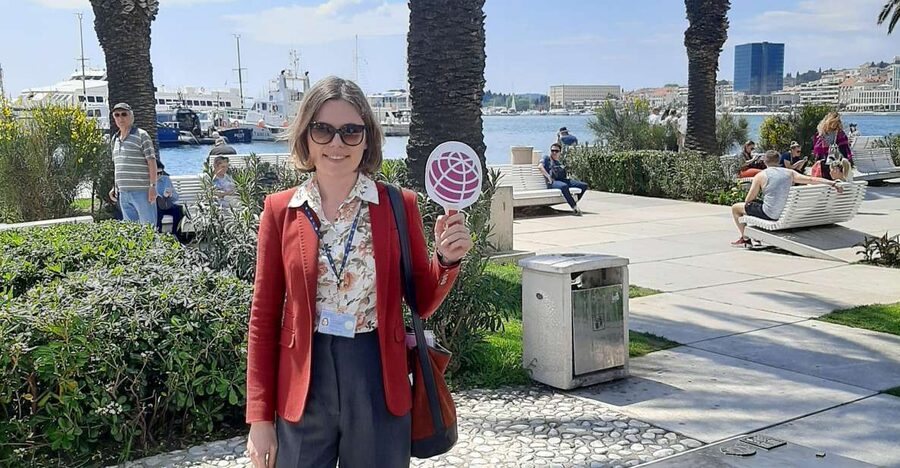
- A 105-minute private walk: Your group has a licensed local guide, rather than joining a larger public tour.
- A palace with a living town inside it: See the Peristil, palace gates, cathedral, Jupiter’s Temple and lanes among medieval houses.
- An optional look below street level: The Palace Substructures, also called the Basements, require a separate entrance fee.
- Beyond the Roman walls: Walk through Pjaca, Fruit Square and Prokurative, where the guide explains later periods of Split’s rule.
- Four guide languages: Tours are offered in English, French, Italian and Spanish.
- A useful first-day orientation: The route links major sights and gives you historical context to use as you explore afterward.
Why a private walk makes sense in Split
Split’s center is compact, but its history can be hard to read at first glance. A Roman structure may have become part of a medieval home, and a street within the palace walls can feel like an ordinary neighborhood until you know what you are looking at. A guide helps connect the pieces while you walk, instead of asking you to puzzle them out alone.
The private format is the main practical advantage. You can hear Sanja without trying to keep pace with a large group, and you can ask questions as they come up. That matters on a route where the interest often lies in the transitions: Roman building reused by later residents, a palace gate leading into a modern street, or a square whose role shifted with the city’s rulers.
The tour is listed at $153 for a group of up to 15. If you fill the group, that works out to about $10 per person; with four people, it is about $38 each. The group rate can be good value for a family or a small party that wants a guided introduction without paying separately for several individual tours. For one or two people, it is a more substantial expense, so consider how much you value a private guide and an efficient orientation.
Sanja is a licensed local guide with a master’s degree. Her tours are available in English, French, Italian and Spanish. Her explanations have been especially praised for clarity, and French-speaking visitors have highlighted how naturally she explains Split’s history in French. If language is important to your booking, choose the option that matches your group.
More walking tours in Split:
- Split: Old Town and Diocletian Palace Walking Tour
★ 4.9 · 4,727 reviews - Walking Tour of Split and Diocletian’s Palace
★ 5.0 · 2,588 reviews - Krka Waterfalls tour with Trogir Walking tour and Krka panoramic boat cruise
★ 5.0 · 1,659 reviews
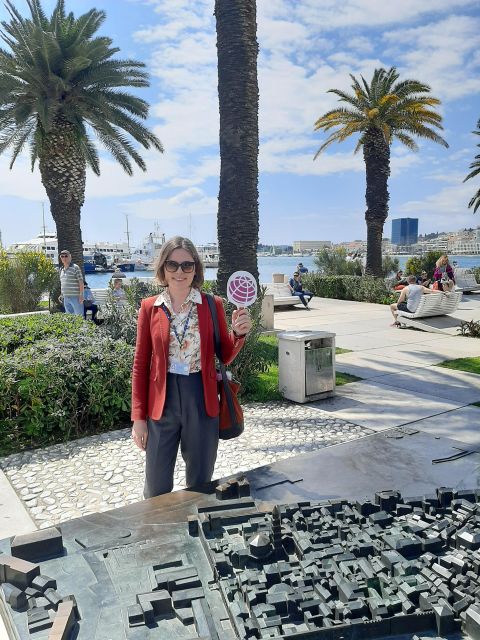
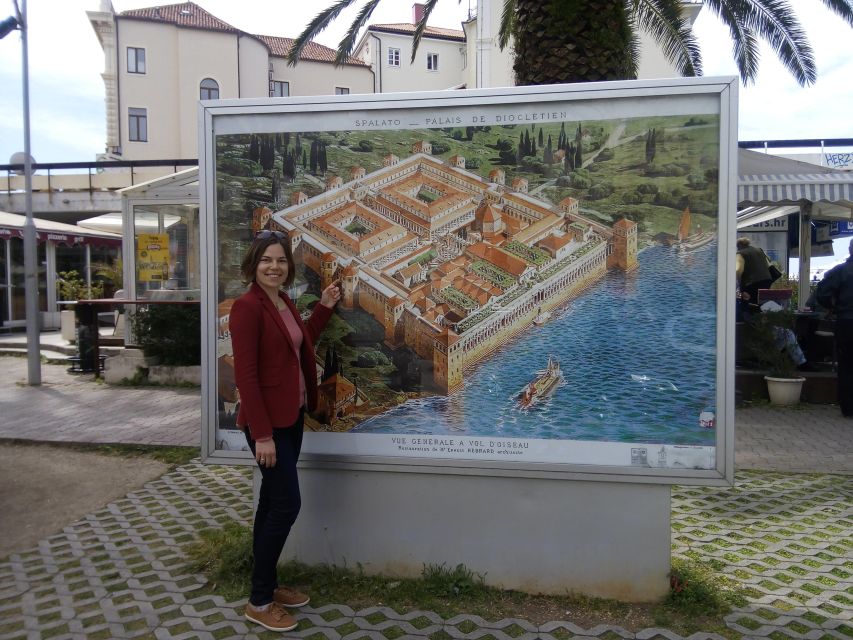
Start by the bronze model on the Riva
Meet by the bronze model of Split’s historic center on the Riva promenade, in front of the palace’s south entrance. It is a useful place to begin: the model gives you a simple overview before you enter the dense web of lanes and courtyards.
The Riva is Split’s seafront promenade, and the palace entrance sits just behind it. From here, the route heads into the old town for about an hour and 45 minutes, then returns to the Riva area. The stated stops add up to a planned circuit rather than a long march across the city, though you should expect frequent pauses for explanation and sightseeing.
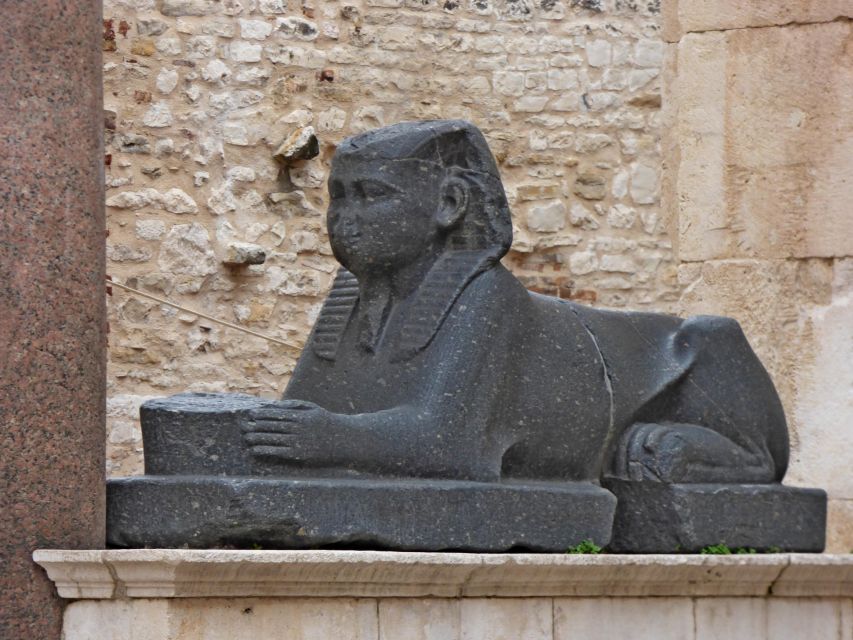
Starting near the south entrance also helps orient you to the palace’s scale. Diocletian’s Palace was built in the 4th century, and it forms the oldest core of Split. It is not simply one grand building. Its walls, gates and internal spaces became the setting for a medieval neighborhood, creating the unusual mix of Roman remains and later domestic architecture that defines this walk.
Inside Diocletian’s Palace
The tour spends about 30 minutes around the palace, the longest stop on the route. That is a sensible use of time: the palace is the central piece of Split’s story, and a quick look at its exterior would leave much of the experience unexplained.
Expect to move through streets and spaces where different periods sit close together. The guide points out the palace walls and four gates, as well as medieval houses built within the ancient footprint. You are not only looking at a Roman monument, but at a town that continued to adapt it for everyday life.
The Palace Substructures are the one part of the visit with a separate entrance fee. Also called the Basements, they form a lower level of the palace and are included as an optional paid visit. If you want to see them, budget for the added cost; the tour price does not cover admission. The rest of the route includes external visits and walks through the historic center, not a general package of paid entries.
This distinction matters when comparing the price with other tours. The private guide and walking tour are covered, but the Substructures are not. You can decide whether to add them based on your interest and budget rather than assuming every site on the route is included.
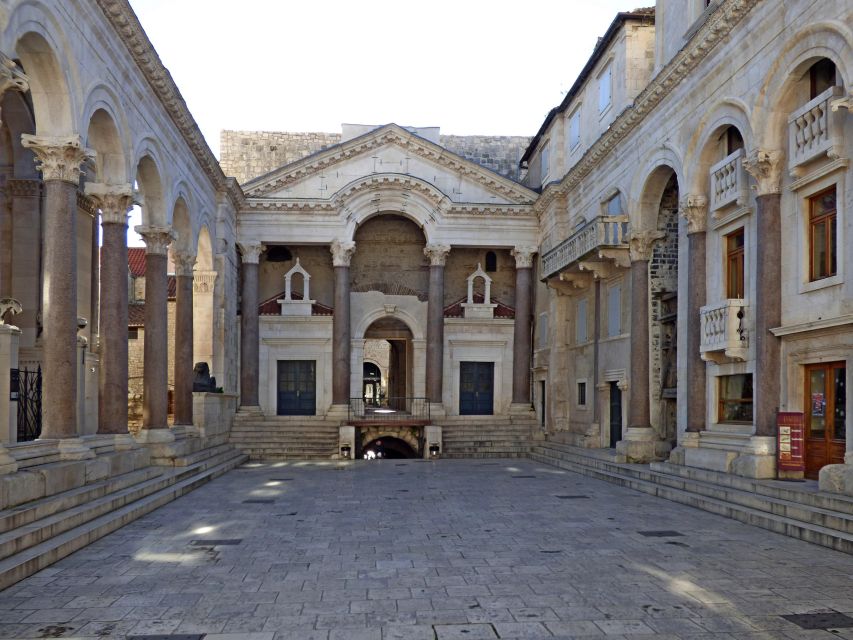
Peristil, the palace’s central square
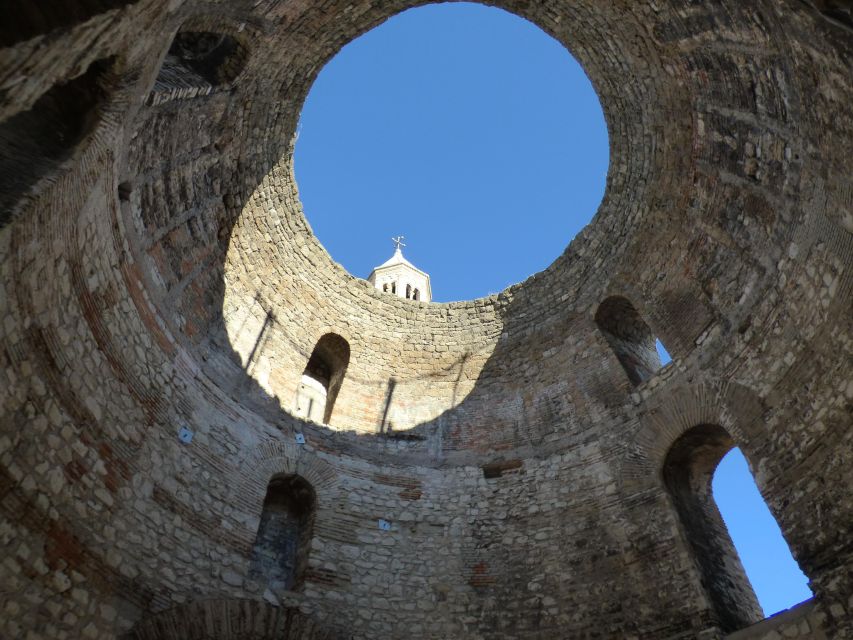
The Peristil gets about 10 minutes. This is one of the palace’s essential spaces, a central square that makes the scale and layout of the Roman core easier to grasp. It is also a good point to notice how the old palace functions as part of the town rather than as a sealed archaeological site.
Your guide explains the setting and its place in the palace, while you take in the surrounding stone and architecture. Ten minutes is enough for an introduction and a look around, but not a long, unhurried visit. If the details catch your eye, you can return after the tour and spend more time here on your own.
That is one of the advantages of doing this walk early in your stay. Sanja can give you context for the places you will pass again, so later visits are less like ticking off a landmark and more like recognizing how the center fits together.
More history tours in Split:
- Walking Tour of Split with a ‘Magister’ of History
★ 5.0 · 1,122 reviews - Split Walking Tour with Professor of History
★ 5.0 · 926 reviews - Split: History and Heritage Walking Tour
★ 4.9 · 650 reviews - Split History and Gastro Small-Group Tour with Food and Drinks
★ 5.0 · 375 reviews
Cathedral of Saint Domnius and Jupiter’s Temple
The cathedral stop is scheduled for about 10 minutes and includes a guided explanation, sightseeing and passing by. The building is also associated with Diocletian’s Mausoleum, a striking reminder of how the city’s religious and architectural uses changed over time. The tour gives you context from outside; it does not promise an interior visit.
Nearby, Jupiter’s Temple is another short stop, also about 10 minutes. The tour visits it externally, with no entrance fee included or required for the described visit. Its later use as a baptistery adds another layer to the story of how Roman spaces and structures were reworked.
These stops are close together, which helps the walk cover several major sights without spending the whole 105 minutes inside buildings. The trade-off is that you should not expect long visits at each one. If entering the cathedral or other interiors is a priority, ask about the exact plan when booking or leave time afterward to explore independently.
Golden Gate and the city beyond the palace
At the Golden Gate, the route pauses for about 10 minutes. The gate is one of the palace’s four entrances, and seeing it helps you understand the boundary between the Roman core and the neighborhoods that grew around it. The palace is not an isolated block in the middle of Split; its gates connect it to the surrounding city.
From there, the tour moves into the medieval neighborhood outside the palace walls. This shift is important. Split’s character did not stop with Rome, and the next part of the walk shows how later communities shaped the spaces around the old core.
The route includes Pjaca, or People’s Square, for about 15 minutes, followed by Fruit Square for about 10 minutes. These squares offer a different scale from the palace interior, with streets and public spaces that reflect the growth of the medieval town. Sanja explains how life and civic identity changed under Venetian, French, Austro-Hungarian and Yugoslav rule.
That historical sweep is one of the tour’s strongest features. Rather than treating Split as a single-period Roman attraction, the walk places its architecture within a longer story of shifting governments and local life. You will not get an exhaustive account of every era in 105 minutes, but you should leave with a clearer framework for understanding what you see.
From Fruit Square to the Riva
Fruit Square is one of the named stops, and the route also includes Prokurative, a square associated with the later town beyond the palace. Together, these stops show how Split’s public spaces differ from the enclosed lanes and ancient core inside the walls.
The tour then returns to the Riva for its final part, with about 10 minutes of guided sightseeing. The seafront gives the walk a natural ending and brings you back close to the meeting area. The listed route ends at the bronze model, so you finish near where you started rather than needing to arrange transport back across town.
The route offers a useful balance: the palace gets the most time, but you also see the medieval town and its later public squares. If you want a specialist tour focused only on Roman architecture, this broader approach may feel brisk. If you want a first look at how the whole historic center developed, the range is a plus.
How to get the best value from the walk
I would book this near the start of a Split stay. One visitor described using the tour on the first full day, then found it helped them appreciate later time spent inside the palace walls. That is exactly when a guide’s orientation is most useful: you can use the route and explanations as a map for your own walks afterward.
Before you go, decide whether you want to enter the Palace Substructures and account for the separate fee. Wear shoes suitable for walking through old-town streets, and be ready to spend much of the tour on foot. The duration is 105 minutes, but the route covers several stops, so it is more about steady movement and frequent short explanations than sitting down for a long lecture.
The tour is not suitable for wheelchair users. The provided information does not specify a walking distance or details about the surface of every street, so if mobility or comfort is a concern, ask the provider for more detail before booking.
For a group, the value improves as more people share the fixed price. A couple may still find the private format worthwhile if personal questions and a flexible feel matter more than the lowest cost. If you are traveling alone and primarily want a basic overview, compare the price with other available options.
Should you book Sanja’s Split walking tour?
Book this if you want a clear, personal introduction to Split’s Roman palace and the medieval town around it. The strongest reasons are the private format, Sanja’s ability to explain the city in several languages, and the route’s broad view of how Split changed under different rulers. It is especially useful early in a visit, when a guide can help you make sense of places you will see again.
Think twice if you want a long visit inside each landmark, need wheelchair access, or want all entrance fees included in the price. The Palace Substructures cost extra, and the 105-minute schedule keeps each stop fairly concise. For a small group that values context and a well-planned first walk, the price can make sense; for a solo visitor seeking the cheapest possible introduction, it may be harder to justify.
FAQ
How long is the tour?
The tour lasts 105 minutes, or about 1 hour and 45 minutes.
What is the price?
The price is $153 per private group of up to 15 people.
Where does the tour meet?
Meet by the bronze model of Split’s historic center on the Riva promenade, in front of the south entrance to Diocletian’s Palace.
Which languages are available?
The live guide is available in English, Italian, French and Spanish.
Is the tour private?
Yes. It is offered as a private group tour.
Is admission to the Palace Substructures included?
No. Entrance fees to the Palace Substructures, also called the Basements, are not included.
Does the tour enter Jupiter’s Temple?
No. Jupiter’s Temple is visited externally, with no entrance fee for the described stop.
Is the tour suitable for wheelchair users?
No. The activity is listed as not suitable for wheelchair users.
What is included in the price?
The price includes a private tour with a professional licensed local guide who has a master’s degree.
Can I cancel for a refund?
Yes. You can cancel up to 24 hours in advance for a full refund.
More private tours in Split
- SPLIT-PRIVATE Walking Tour of Diocletian’s Palace & Old Town
★ 5.0 · 467 reviews - Private Krka Waterfalls tour with 30min Boat Cruse
★ 4.0 · 458 reviews - Split by Private Electric Rickshaw – Palace & Hidden Gems
★ 5.0 · 412 reviews - Private Blue cave, Mamma Mia and Hvar, 5 islands tour from Split
★ 5.0 · 387 reviews
Just reviewed in Split
- Split City Walking Tour★ 5.0 · 5 reviews
- Split City Electric Bike Tour★ 5.0 · 68 reviews
- Split Cooking Class – Afternoon Edition Shared Activity★ 5.0 · 8 reviews
- Marjan Park & Split City Bike Tour★ 5.0 · 51 reviews
- Split: Blue Lagoon & 3 Islands Speedboat Tour – Small group★ 4.5 · 46 reviews
- Split Quest Experience: Discover the City★ 3.5 · 5 reviews
- Private transfer Split Airport to Split★ 5.0 · 28 reviews
- Split Bike and Wine Experience★ 5.0 · 3 reviews
Split History Tours, compared.
Walking Tour of Split with a ‘Magister’ of History
Read our review →
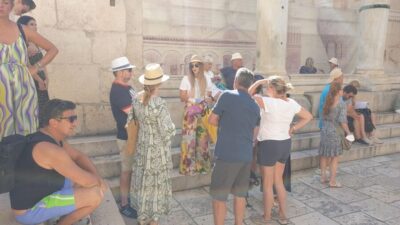
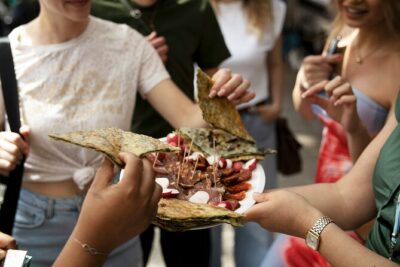
Split History and Gastro Small-Group Tour with Food and Drinks
Read our review →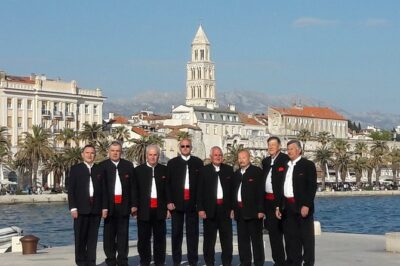
PREMIUM Emperor’s Walking Tour for History Lovers + Museum
Read our review →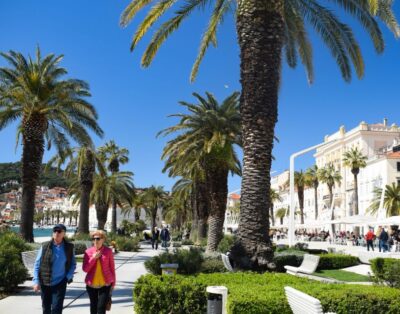
Local History and Culture 90-Minute Walking Tour
Read our review →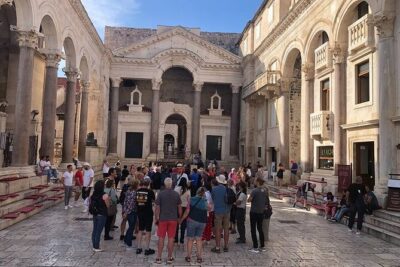
Historical & Gastro Treasures Tour with Green Market
Read our review →Browse the lists this tour appears in