
Review · SPLIT WALKING TOURS
Trogir walking tour with a local guide
Trogir’s best introduction is a walk through its tightly packed Old Town, where a cathedral portal, a Venetian loggia, and a waterfront promenade sit within easy reach of one another. I like this tour for two reasons: it gives you a clear route through the main sights, and its local guides add personal stories about growing up in Trogir to the historical context.
The main consideration is the pace. There is a lot to cover in about 90 minutes, and one account describes a tour that finished after an hour, so you should not count on a long visit inside every landmark. If you want a concise orientation rather than a slow, in-depth visit to each site, the format makes sense.
- A close look at Radovan’s Portal: See the intricate 13th-century entrance to the Cathedral of St. Lawrence.
- A small group: The tour is capped at 15 people, a useful size for a walk through narrow Old Town streets.
- Local stories, not just dates: Guides including Daniela, Kristina, Blanka, and Michael have been praised for adding personal experience and anecdotes.
- An easy route through the highlights: The walk links the central square, civic buildings, palaces, Riva, and Kamerlengo Castle.
- A short, low-cost introduction: At $18.14 per person for about 90 minutes, it can help you decide what to revisit on your own.
- A weather-dependent plan: The tour needs good weather, and the stated cancellation terms are strict if you cancel yourself.
A compact walk through Trogir’s long story
Trogir’s Old Town is small enough to cross on foot, but its streets hold centuries of architecture and civic life. This tour uses that compact scale well. Rather than sending you between distant sights, it connects important buildings in a steady walk, with the guide explaining how the town’s different eras fit together.
That context is part of the value. Trogir’s landmarks are not all from one period or built for one purpose. A Romanesque and Gothic cathedral, a Renaissance palace, a church built after a plague, and a waterfront fortress each tell a different part of the town’s story. A local guide can help you notice those layers instead of treating the walk as a checklist.
The tour is offered in English and lasts about an hour and a half. It begins at Ul. Gradska vrata 5 and ends on Obala bana Berislavića by the waterfront. The group limit of 15 keeps the experience small enough for questions and conversation, though it is still a shared walk rather than a private visit.
Radovan’s Portal and the Cathedral of St. Lawrence
The Cathedral of St. Lawrence is the natural starting point for understanding Trogir’s architecture. Construction began in 1213 and continued for five centuries, leaving a building with three naves and a blend of Romanesque and Gothic styles. That long building history explains why the cathedral is more than one neat architectural statement: it reflects changing tastes and generations of work.
The featured stop is Radovan’s Portal, the cathedral’s main entrance. Master Radovan, a craftsman from medieval Trogir, carved this remarkable work in the first half of the 13th century. You get around 10 minutes here, with no admission ticket required for the stop as described. That is enough to look closely at the carved entrance and hear why it matters, though not enough for a thorough visit to every part of the cathedral.
The bell tower is also noted for its panoramic views over Trogir, Čiovo, the mainland, and the Adriatic. The tour information does not say that tower access is included, so treat it as a separate possibility to investigate rather than part of the guided walk. If you want to climb, leave yourself time and check the arrangements locally.
More walking tours in Trogir:
- Trogir: City Highlights Guided Walking Tour
★ 4.9 · 199 reviews - Private Trogir walking tour with LOCAL guide
★ 4.8 · 23 reviews - Discover Trogir: Guided Walking Tour of a Medieval Gem
★ 5.0 · 13 reviews
John Paul II Square: the town’s open-air living room
Next comes John Paul II Square, known in Croatian as Trg Ivana Pavla II. About 15 minutes here gives you time to take in one of Trogir’s most attractive public spaces, framed by important historic buildings and lined with café tables and umbrellas.
I like the square as a pause in a walking tour because it shows how the Old Town works today, not only how it looked in the past. People meet, sit over coffee, or stop for ice cream beneath the surrounding architecture. The guide can point out the landmarks, then you can return later and enjoy the place at your own pace.
The trade-off is that a guided stop is brief. If the cafés and atmosphere appeal to you, plan to come back after the tour rather than expecting time for a leisurely break during it. The square is also a useful landmark for finding your way around the historic center once the walk ends.
Town Hall, the clock tower, and the Town Loggia
The Town Hall dates to the 15th century and is known for its stone construction and elegant courtyard, decorated with coats of arms. Its outside staircase is a striking example of Venetian architecture in Trogir. The stop lasts about 10 minutes, enough for an explanation and a look at the exterior details.
Nearby, St. Sebastian’s Church and its clock tower were built in 1476. The church was commissioned by Trogir’s citizens in gratitude for deliverance from the plague, and its architect was Niccolò di Giovanni Fiorentino, also known in English as Nicolas of Florence. That background gives the modest-looking church a human story: it was built as an act of thanks, not simply as another ornament on the square.
The Town Loggia, beside the clock tower, dates to the 13th century. It once served as a gathering place where residents discussed public matters. The local court also met there on certain days to announce laws and handle cases. These civic spaces help you picture Trogir as a working community, not a collection of handsome façades.
The schedule allows roughly 10 minutes at the church and clock tower, and another 10 at the loggia. Those short stops suit an overview. If you want to study inscriptions, architectural details, or the history of the court at length, you will want to linger after the guide moves on.
Cipiko Palace and the layers of Venetian Trogir

The Great Cipiko Palace is a group of Romanesque buildings reshaped between the 15th and 17th centuries into a Venetian Renaissance residence. Niccolò di Giovanni Fiorentino also worked on the project and carved the palace’s south portal.
This is one of the tour’s shorter stops, at about five minutes. The quick look makes sense in a walk designed to cover many sites, but it means the palace is best appreciated as part of the broader architectural picture. Listen for how its earlier buildings were adapted rather than replaced: that layering is a recurring feature of Trogir.
The Old Town Museum occupies a series of palaces once owned by the Venetian Garagnin-Fonfogna family. It is near the North Gate, one of the two main historic entrances into the former walled town. The tour details identify the museum and its location, but do not give it a timed stop, so do not assume a museum visit is part of the 90-minute route. You can use the guide’s orientation to decide whether to return and explore inside.
More guided tours in Trogir:
- Zagreb to Split Group Transfer with Plitvice Lakes guided Tour
★ 4.5 · 242 reviews - Split to Zagreb Group Transfer with Plitvice Lakes guided tour
★ 4.5 · 119 reviews - From Split: Plitvice Lakes National Park Guided Tour
★ 5.0 · 3,002 reviews - From Split: Plitvice Lakes Guided Tour with Entry Tickets
★ 4.9 · 2,468 reviews
A quieter church, a fleeting moment, and the waterfront
The Church of Our Lady of Mount Carmel lies just off the western part of the Old Town’s waterfront promenade. Founded in the Middle Ages, it is associated with Trogir’s fishermen, craftsmen, and laborers. If you are in town on July 16, the church’s traditional evening procession with a statue of Our Lady is a specific local event to keep in mind.
Another detail on the route is a bas-relief of Kairos, the Greek personification of the opportune moment. The figure is shown poised to fly away, holding scales, with a long lock of hair at the forehead and a bald crown. The traditional image offers a memorable lesson: seize the right moment by its forelock, because once it has passed, there is nothing to grasp. It is an unusual piece of symbolism to encounter amid the town’s churches and palaces.
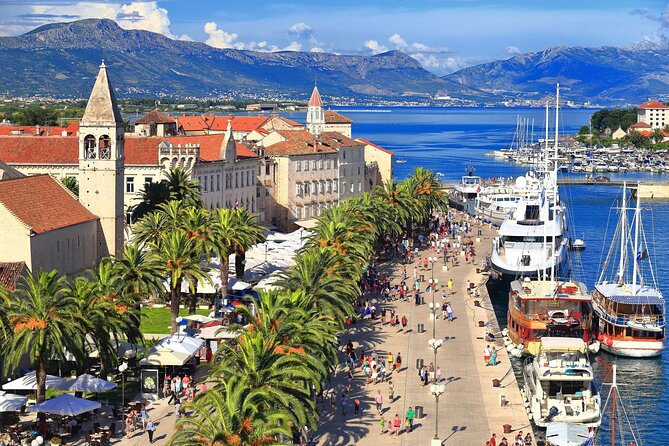
The walk then reaches the Riva, Trogir’s palm-lined waterfront promenade. It is broad, flat, and straight, with views across the channel toward Čiovo. The planned stop is about 10 minutes. After the close quarters of the Old Town, the open water provides a welcome change of scale and a good place to orient yourself toward the island.
Kamerlengo Castle and the end of the walk

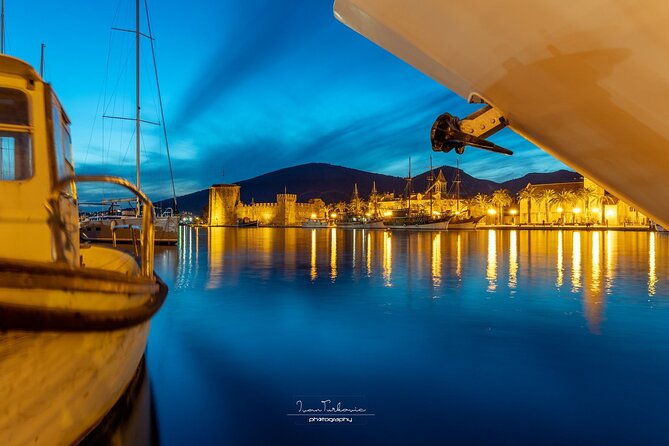
At the end of the promenade, Kamerlengo Castle occupies a corner of the small island where the Old Town stands. The early 15th-century fortress is an imposing finish to the route and a reminder of Trogir’s strategic position beside the sea.
The castle sits beside everyday modern spaces, including a local football pitch, a small playground, and stalls belonging to local tour operators. That mix keeps the setting from feeling like a sealed-off monument. You are looking at a historic defense structure in the middle of a lived-in town.
The tour ends on Obala bana Berislavića, by the waterfront. From there, you can continue along the Riva or make your way back into the Old Town. The listed route does not specify a castle admission or interior visit, so think of this as an exterior stop unless the guide confirms otherwise.
What the local guides add

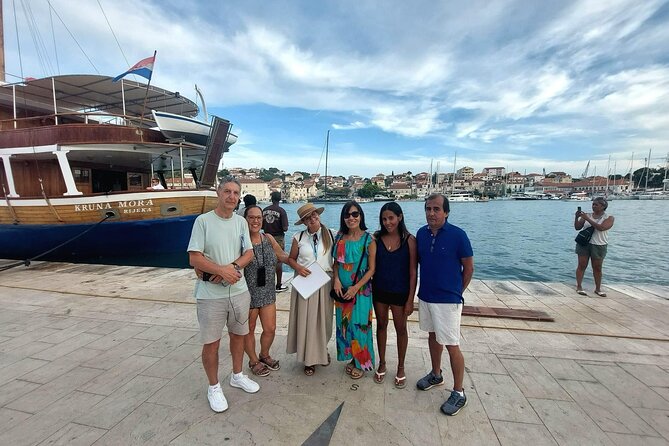
The most useful part of a short town walk is often the person telling the story. Guides named Daniela, Daniella, Kristina, Blanka, Christina, Michaela, and Michael have led this experience. Names vary, so you should not book expecting a particular guide unless the provider confirms one.
The qualities repeatedly associated with the guiding style are enthusiasm, clear historical explanations, and personal connections to the region. Daniela and Kristina, in particular, have shared stories about growing up in Trogir and about family life there. One account describes a guide whose family had been in the region for 400 years, while another notes personal memories tied to the Homeland War. These details can make the town’s history feel less abstract, though the depth of personal storytelling will depend on the guide and the group.
Guides also connect Trogir’s past to Croatia more broadly. That is helpful if this is your first stop in the country or if you have seen several coastal towns and want a better sense of how their histories relate. A guide named Blanka has also recommended a beach for after the walk, an example of the practical local advice you may get in conversation.
Is $18.14 good value for 90 minutes?
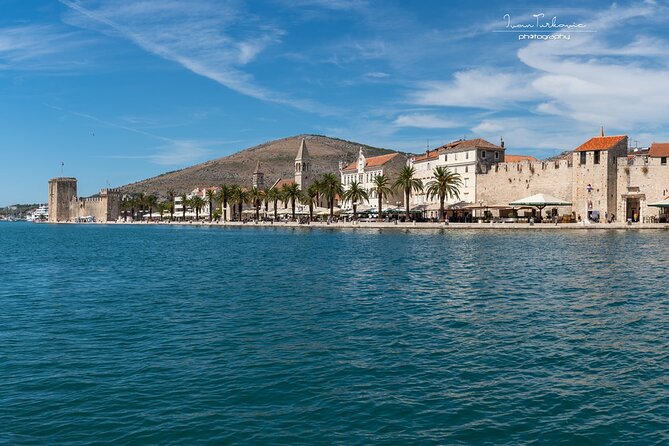
At $18.14 per person, the tour is a modest investment for a guided introduction to the main sights. The price buys more than directions between landmarks: it gives you an organized route, historical explanation, and a chance to ask questions. The free admission noted at several stops also means the fee is for the guiding experience, not entry tickets to those sights.
The value depends on what you want. If you like having the town’s monuments explained while you walk, the price is reasonable. If you prefer to linger inside buildings, climb the cathedral tower, or spend a long time at the museum, you may need to add independent visits and separate time.
The stated duration is approximately 90 minutes, but one account described a walk that ended after 60 minutes, despite expecting a longer tour. That is worth keeping in mind if you are planning a tight schedule. Treat the tour as a short orientation with some variation in pace, not a guarantee of a full 90 minutes of nonstop commentary.
Who should take this walk?
I would put this tour near the start of a Trogir stay. One guide helped an early arrival sort out what to prioritize during a three-night visit, which is exactly what a compact walking tour can do well. Once you have the route and the main names in mind, you can return to the cathedral, museum, or a favorite square with more purpose.
It also suits visitors who enjoy history told through people and place. The personal stories are a strong part of the experience, and the group size is limited to 15. On the other hand, if you want a specialist architectural lecture or an unhurried interior visit, this broad town walk may feel too brisk.
The walk is outdoors and requires good weather. Most people can participate, according to the tour information, but no further accessibility details are provided. Wear footwear suited to walking through the historic center, and plan for the possibility that the pace or length may vary.
Should you book the Trogir walking tour?
Book it if you want an affordable, English-language introduction to Trogir’s landmarks and appreciate a guide who can connect local history with personal experience. The route covers a useful range, from Radovan’s Portal and the central square to the Riva and Kamerlengo Castle, without requiring a full day.
Skip it if your main goal is to spend extended time inside monuments or you need a precisely timed 90-minute activity. The walk’s strongest appeal is its combination of orientation, architecture, and local storytelling. Take it early in your stay, then return to whichever places deserve a slower look.
FAQ
How long is the Trogir walking tour?
It lasts approximately 1 hour and 30 minutes. The duration is approximate, so allow some flexibility in your plans.
How much does the tour cost?
The listed price is $18.14 per person.
What language is the tour offered in?
The tour is offered in English.
How many people can join?
The maximum group size is 15 travelers.
Where does the tour start and end?
It starts at Ul. Gradska vrata 5, 21220 Trogir, Croatia, and ends at Obala bana Berislavića, 21218 Trogir, Croatia.
Are admission tickets included?
Several stops are marked as requiring no admission ticket, including Radovan’s Portal and the listed central sights. The tour details do not confirm entry to the cathedral tower, museum, or castle interiors.
Can most people participate?
The activity information says most travelers can participate. It does not provide further accessibility details.
What happens if the weather is poor or I cancel?
The tour requires good weather. If it is canceled because of poor weather, you are offered a different date or a full refund. If you cancel or request an amendment yourself, the experience is non-refundable and cannot be changed.
Just reviewed in Trogir
- From Trogir, Seget, Okrug: Krka Waterfalls & Šibenik Culture Tour★ 5.0 · 10 reviews
- Krka Waterfalls & Primošten from Trogir, Seget, Čiovo & Kaštela★ 5.0 · 18 reviews
- From Split & Trogir: ATV Quad Tour on Island Čiovo★ 5.0 · 21 reviews
- Slatine – Island Hopping Excursion (Trogir/Blue Lagoon/Shipwreck)★ 4.0 · 24 reviews
- Island Hopping Boat Excursion with Lunch (Trogir,Blue Lagoon, Šolta)★ 3.5 · 6 reviews
- Split and Salona Cultural Heritage Day Tour from Trogir★ 4.0 · 3 reviews
- Split: Private tour to Salona, Vitturi castle and Trogir★ 5.0 · 6 reviews
- Split and Trogir private tour *ideal for cruise ship guests*★ 5.0 · 3 reviews
Split Walking Tours, compared.
Walking Tour of Split and Diocletian’s Palace
Read our review →
Krka Waterfalls tour with Trogir Walking tour and Krka panoramic boat cruise
Read our review →
Walking Tour of Split with a ‘Magister’ of History
Read our review →
PREMIUM Emperor’s Walking Tour for History Lovers + Museum
Read our review →
Browse the lists this tour appears in