
Review · SPLIT WALKING TOURS
Daily or night walking tour through Medieval Šibenik
Šibenik’s medieval story is written into its stone: a cathedral built over 105 years, a public cistern designed to withstand drought and siege, and carved details that turn church walls into history books. This 90-minute walk with local guide Dario Mikulandra links those sights with the lanes and passages between them.
I like that the tour pairs St James Cathedral with smaller, easily missed details, including a medieval depiction of doctors and a stone bowl for dogs. I also like the choice of daytime or evening outings, plus a small group capped at 10, which should make it easier to hear the stories and ask questions.
One consideration: the route gives substantial attention to churches and religious life. That suits visitors curious about medieval architecture and society, but if you mainly want political or everyday history, Dario’s emphasis may feel more devotional than you expect.
Šibenik’s medieval details, at a glance
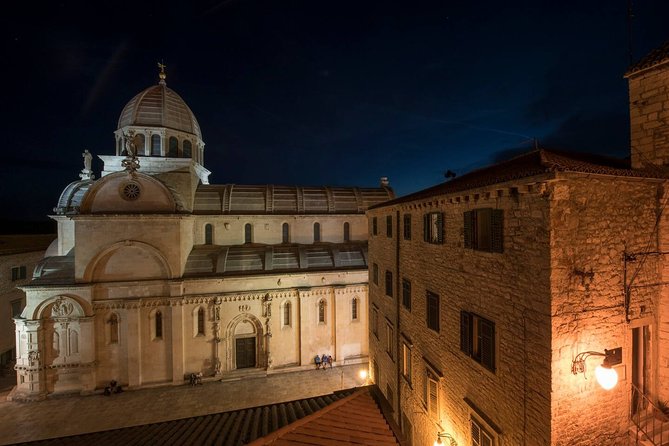
- A 105-year building project: Learn how the Cathedral of St James was designed and built, and look for the hidden signature of master builder Juraj Dalmatinac.
- A cistern built for hard times: See the Four Wells Square and learn how its underground water system helped the city face drought and military sieges.
- Small carvings with big stories: Look for a physician’s relief, carved fruit and vegetables, and an unusual stone dog bowl.
- Day or night, in English: Choose the time that suits you; the walk lasts about 90 minutes.
- A compact group: The tour has a maximum of 10 participants, and the route returns to its starting point.
Start with the cathedral that took 105 years
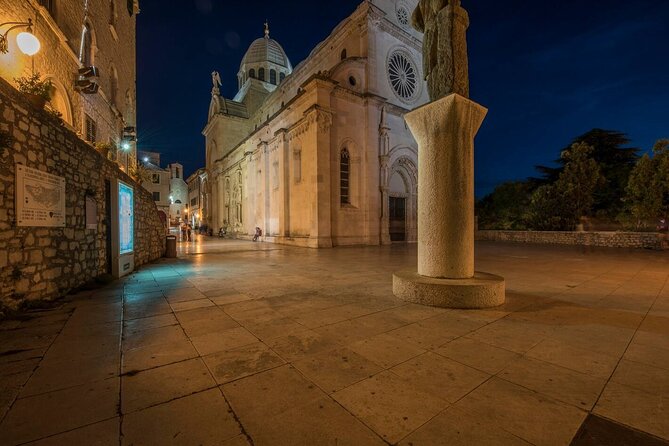
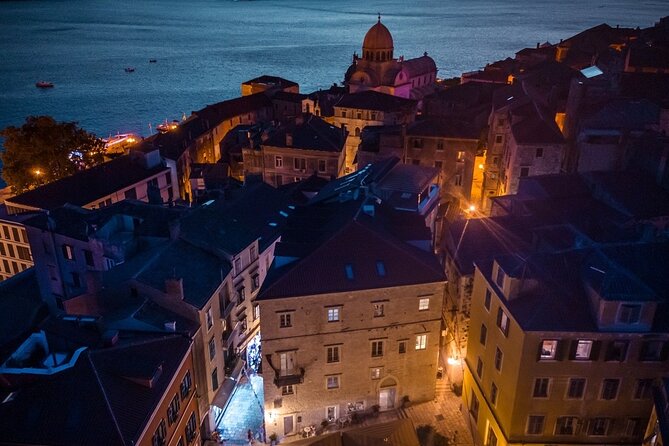
The Cathedral of St James is the anchor of the walk, and for good reason. It is a UNESCO World Heritage Site and one of the defining works of Croatian culture from the 15th and 16th centuries. Rather than simply taking in the façade and moving on, you hear how the construction unfolded, what came before it, and how the building brought Gothic and Renaissance ideas together.
Dario explains the role of Juraj Dalmatinac, the master builder associated with the cathedral, and points out the hidden signature he left on his work. The tour also uses the building’s details to make medieval church design more legible: why there are so many shells, why fruit and vegetables appear in the presbytery, and what the many sculpted heads might tell you about the people and ideas represented there.
The cathedral is built entirely of stone, a fact that makes its construction especially striking. You’ll hear how the builders worked with the material and why the structure is considered one of the Mediterranean’s notable Gothic-Renaissance cathedrals. The planned stop is about 30 minutes, enough time for a guided look at the building rather than a full, unhurried visit to every feature.
The religious focus is part of the value here. The guide connects theology with medieval church architecture, so the carvings and layout gain context. If you’re looking for a tour centered chiefly on trade, politics, or daily life, keep in mind that the cathedral and church stories take up much of the walk.
More walking tours in Sibenik:
- Private Sibenik Walking Historical Morning or Evening Tour
★ 5.0 · 93 reviews - Sibenik: Guided Evening Walking Tour
★ 4.9 · 62 reviews - Šibenik: Medieval Night Walking Tour
★ 5.0 · 19 reviews
St Barbara’s church and the physician carved in stone
A short walk brings you to the Church of St Barbara, a single-nave Gothic building whose construction began around 1400. Above the main entrance, look for a niche with a statue of St Nicholas, made by the Italian sculptor Bonino of Milan.
The most unusual detail is on the north wall: a sculpted image connected to a Šibenik doctor named Marko, made as a vow in 1419. It is described as a rare medieval depiction of physicians on the eastern Adriatic coast. That one carving gives the church a wider social history, showing how people commemorated skilled work and personal devotion in stone.
This is a brief stop, about 10 minutes, so it works best as a close look and a focused story rather than a long church visit. If you enjoy noticing details that could disappear into the background on a solo walk, this is one of the route’s clearest examples of why a guide helps.
Four Wells Square: water stored beneath the town
The Four Wells Square lies only a short distance from the cathedral. Beneath the open square is a medieval public cistern, built to give Šibenik a dependable water supply during droughts and military sieges. Construction was contracted in 1446 and supervised by Juraj Dalmatinac. The cistern could hold 28,000 barrels, and a special tax helped pay for it.
Above ground, four well openings mark the place where people drew water. The square has been renovated, and the cistern’s underground interior includes a café and wine bar. During the tour, you’ll have the chance to see the water-storage complex, its filtration system, and the four openings through which fresh water was taken.
This 15-minute stop is a useful reminder that medieval city life depended on practical infrastructure as much as grand churches. A water system could mean the difference between coping with a dry spell and enduring a crisis. The square’s present-day use also makes the site feel less like a sealed monument and more like a place woven into the city.
St John’s church: clocks, carved fruit, and iron hoops
The Church of St John, first known as the Church of the Holy Trinity, dates to the 15th century and combines Gothic and Renaissance features. Its south-side staircase is the work of Šibenik builder Ivan Pribislavić and is decorated with bas-relief.
Look closely at the bell tower and its details. A one-handed Turkish clock was brought from Drniš after the Turks left the area in the 18th century. A Renaissance window by Nikola Firentinac, also known as Nicholas of Florence, is decorated with fruit and vegetables. Nearby are a relief of a lamb and a winged angel, and the guide also points out mysterious iron hoops on the church’s north wall.
Dario’s explanations connect these objects to the people who built and used the church. The stop lasts about 10 minutes, so expect a compact dose of architectural history. The mix of a clock, a carved window, and unexplained ironwork gives you plenty to look for as you continue through the old center.
More evening outings in Sibenik:
- Sunset Sea Private Kayaking in Vodice
★ 5.0 · 11 reviews - Kayaking Sunset Tour
★ 5.0 · 4 reviews - Split: Illuminated Evening Guided Kayaking Tour
★ 4.8 · 1,622 reviews - Split: Stand Up Paddleboard Night Glow Tour
★ 4.9 · 916 reviews
St Francis and the city’s Franciscan past

The Church of St Francis sits at the southeastern edge of Šibenik’s historic center. Built in the second half of the 14th century, it is a spacious, single-nave Gothic church with a comparatively plain exterior. Its main entrance has a Gothic stone frame, while a chapel holds an organ made by the noted instrument builder Petar Nakić.
The adjoining Franciscan monastery adds a literary and cultural thread to the route. Its library holds a collection of 151 incunabula, along with manuscript codices. The monastery is also associated with the Šibenik Prayer, an early Croatian literary and linguistic text written in Latin around 1375.
Nearby, you’ll see remains of the eastern city walls and the Vrančić Palace, where Antun and Faust Vrančić were born. This stop broadens the walk beyond church façades: it brings in learning, written culture, and people connected with Šibenik’s past. The supplied schedule does not give this stop a separate duration, so it is best understood as part of the route rather than a lengthy independent visit.
St Spirit and the role of medieval brotherhoods
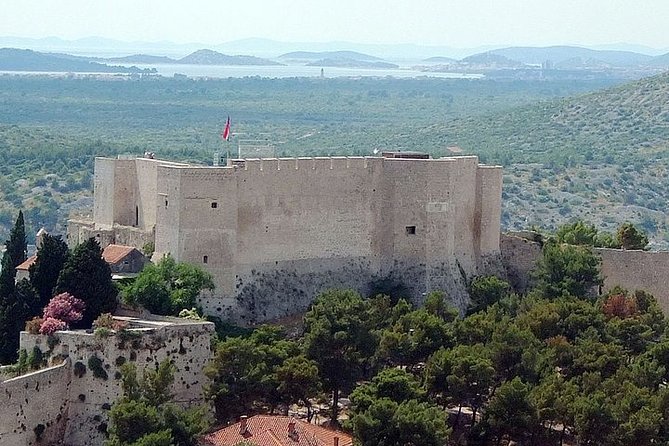
The Church of St Spirit stands on Dinko Zavorović Square and was built in the 17th century to a design by Antun Nogulović. It is one of three churches within a short distance of one another, each linked to an important medieval fraternity.
Here, Dario explains who belonged to these brotherhoods and what part they played in society. The stop also introduces the local custom of ringing Šibenik’s church bells on the night of December 17 to 18 to announce the approach of Christmas. It’s a brief, five-minute stop, but it gives the dense cluster of churches a social context: these were not only places of worship, but institutions tied to community life.
Medulić Square: old measures and a dog’s drinking bowl
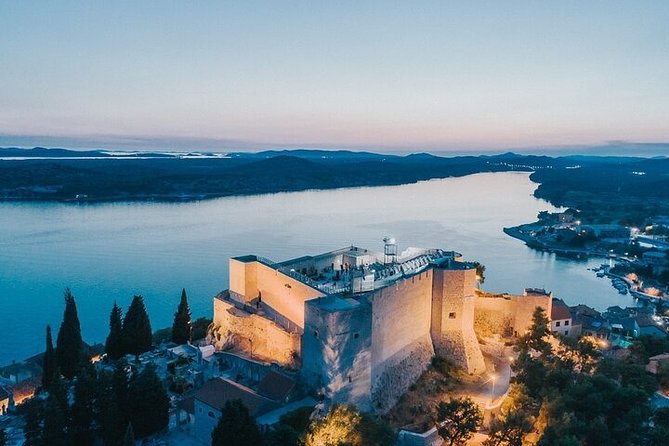
Medulić Square was once the seat of a small trading lodge. In the Middle Ages, measuring goods fairly was no small matter, so the walk looks at the official units used by the Venetian Republic and the city of Šibenik, still displayed on a palace wall. It’s a practical subject that makes the past feel close: merchants needed shared standards just as much as builders needed reliable plans.
The square has another curious detail: a stone bowl marked AMOR D. CANI, made for a dog. Nearby, at Divnić Palace, a copy of a lamp recalls Šibenik’s early electric lighting. The city received alternating electricity and lighting from a hydroelectric plant on the Krka River in 1895, making it the first city in Europe to receive this kind of power, according to the tour’s account.
This final 15-minute stop is a good example of the route’s variety. It moves from trade and measurement to a dog’s bowl and the arrival of electric light. Those details help balance the church-heavy sections with glimpses of commerce and everyday urban life.
What the pace and group size mean for you
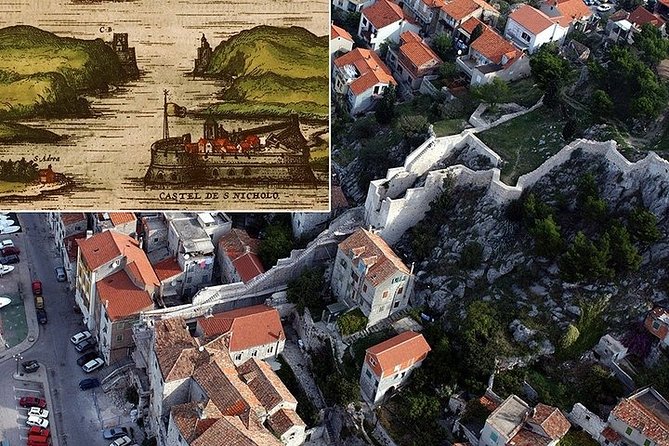
The full walk takes about an hour and a half and is offered in English, by day or at night. A small group capped at 10 is a practical advantage in Šibenik’s narrow streets: you’re more likely to hear the guide and follow along when he points out a carving or architectural feature.
The route involves stone steps, an important part of the old town’s layout. If you move slowly on steps, allow yourself time and tell Dario; one participant specifically praised his patience with this. The tour is not described as unsuitable for most people, but the steps are worth considering when deciding whether the route will be comfortable for you.
The meeting point is Ul. Biskupa Fosca 9, and the walk ends back there. The listed price is $29.79 per person. For that amount, you get a guided introduction to major landmarks and smaller details that are easy to miss on your own, plus a clear sense of how Šibenik’s religious, commercial, and civic life fit together. You are paying for interpretation and local context, not transport or a long museum visit.
The guided approach is particularly useful at the cathedral, where the construction story, iconography, and hidden signature can turn a quick exterior look into a much more meaningful visit. The group size and 90-minute format also keep the commitment modest. If you want to linger inside each church or explore the city at your own pace, treat this as an orientation walk and plan extra time afterward.
Is Dario’s Šibenik walk right for you?
Book this tour if you care about medieval and Renaissance architecture, enjoy stories tied to specific details, or want an informed start to exploring Šibenik on your own. Dario Mikulandra is described as enthusiastic and patient, and his strongest material centers on the cathedral and the city’s religious and architectural history.
Think twice if you want a broad, secular survey of the town or prefer to spend longer at each stop. The tour’s religious emphasis is real, though the cistern, trade measures, city walls, and electricity story add welcome variety. At $29.79, it offers good value for a compact, expert-led introduction, especially if you plan to keep exploring after the walk.
FAQ
How long is the walking tour?
It lasts approximately 1 hour and 30 minutes.
Is the tour offered in English?
Yes. The tour is offered in English.
Can I choose a daytime or nighttime tour?
Yes. The experience is offered as a daytime or nighttime walking tour.
Who leads the tour?
The experience is led by personal tour guide Dario Mikulandra.
How many people can join?
The maximum group size is 10 participants.
Where does the tour start?
It starts at Ul. Biskupa Fosca 9, 22000 Šibenik, Croatia.
Where does the tour end?
The tour ends back at the meeting point.
Which major cathedral does the route visit?
The route visits the Cathedral of St James, a UNESCO World Heritage Site.
Does the tour include the medieval cistern?
Yes. The route visits Four Wells Square and includes a look at the underground cistern complex, its filtration system, and the four water openings.
What is the price per person?
The listed price is $29.79 per person.
Just reviewed in Sibenik
- Krka National Park & Zipline Šibenik – Čikola Canyon★ 5.0 · 3 reviews
- Exploring Vodice on Two Wheels★ 5.0 · 5 reviews
- Zipline Šibenik★ 5.0 · 3 reviews
- Šibenik Riviera boat tour: Zlarin + Prvić + Tijat★ 4.5 · 71 reviews
- Kayaking to the island Prvić★ 5.0 · 31 reviews
- The Best of Sibenik Private Walking Tour★ 5.0 · 13 reviews
- Via Ferrata tour – Čikola Canyon★ 5.0 · 20 reviews
- Zipline Šibenik – Čikola Canyon★ 5.0 · 48 reviews
Split Walking Tours, compared.
Walking Tour of Split and Diocletian’s Palace
Read our review →
Krka Waterfalls tour with Trogir Walking tour and Krka panoramic boat cruise
Read our review →
Walking Tour of Split with a ‘Magister’ of History
Read our review →
PREMIUM Emperor’s Walking Tour for History Lovers + Museum
Read our review →
Browse the lists this tour appears in