
Review · SPLIT WALKING TOURS
Sibenik: Guided Walking Tour
Šibenik’s St. James’s Cathedral is built entirely of stone without mortar, and its exterior bears more than 70 carved human faces. This 90-minute walk leads you from the waterfront through the old town to that remarkable finish, with a guide to explain the city’s past and present along the way.
I like two things in particular: the route links everyday places, including the Riva and Poljana Square, with major landmarks, and the private format gives you a chance to ask questions as you go. The guide’s local stories can add the amusing, less obvious details you won’t get from a printed guide.
One consideration: the old town’s narrow cobbled streets are not suitable for people with mobility impairments. Cathedral entry also costs extra, so allow for the €5 admission fee if you plan to go inside.
- The walk begins at Gat Krka, a waterfront parking lot next to a gas station.
- A local guide connects the city’s past and present, including stories beyond standard guidebook facts.
- The route takes 90 minutes, from the Riva through the old town to St. James’s Cathedral.
- The cathedral’s stonework is the high point, with more than 70 carved faces on its exterior.
- This is a private group tour in English, Croatian or Russian.
- The €57 price covers the guide and walk, but not cathedral admission, food, drinks or gratuity.
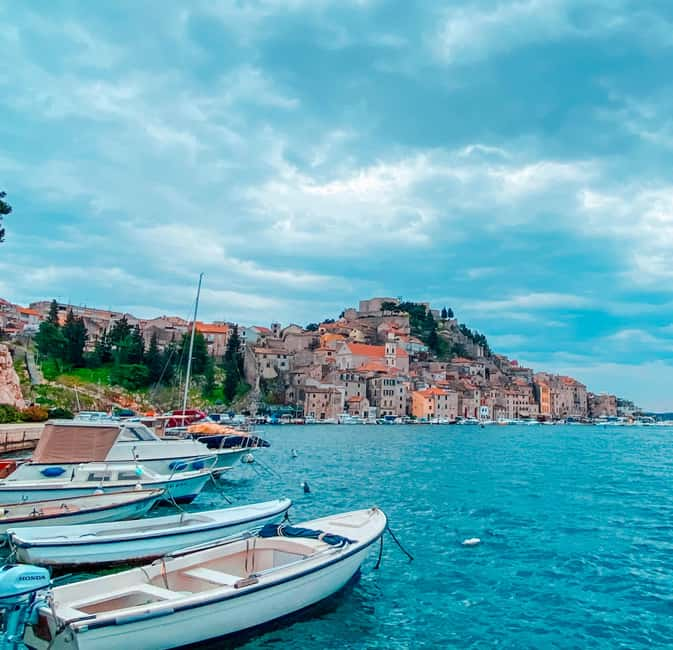
Start at Šibenik’s Riva
The tour begins at Gat Krka, a parking area on the waterfront next to a gas station. It is a practical meeting point, though not a grand historic square, so look for the location by the water rather than expecting a formal visitor center. The walk starts on the Riva, Šibenik’s seafront promenade.
From here, you get a first look at the city’s relationship with the Adriatic and the way its buildings rise behind the shore. Cafes and restaurants line the promenade, where locals and visitors pause by the water. Your guide can set the scene before you head inland, giving you a useful overview of the place you are about to explore on foot.
I like beginning here because it gives the old town a geographic context. You see the harbor and the historic center together, rather than meeting the city as a string of monuments. The stop is also an easy place to orient yourself before the route turns into smaller streets.
The promenade is a public waterfront, not a secluded viewpoint. If you are hoping to spend time over a drink or meal, plan that separately; food and drinks are not included in the tour.
A quiet pause in Mediterranean Park
A short walk brings you to Mediterranean Park, also called Perivoj Roberta Visianija. The garden offers a change of pace from the seafront and the stone streets, with flowers, shade trees and Mediterranean plants in a green pocket within the city.
The park is named for Croatian botanist Roberto de Visiani. That detail gives the stop more meaning than a simple stroll through a pleasant garden: it ties the city’s public spaces to a local figure and to the region’s plant life. The guide can help you notice how this calm patch fits into Šibenik’s daily rhythm.
For you, this is a breather in a compact walking route, and a chance to take in a different side of the city before moving on. The park is not presented as a long stop or a botanical tour, so keep expectations modest. Its value is in the contrast and in the local context your guide brings to it.
More walking tours in Sibenik:
- Private Sibenik Walking Historical Morning or Evening Tour
★ 5.0 · 93 reviews - Sibenik: Guided Evening Walking Tour
★ 4.9 · 62 reviews - Šibenik: Medieval Night Walking Tour
★ 5.0 · 19 reviews
Poljana Square, where old and new meet
From the park, the route continues to Poljana Square, the main square of Šibenik. It is an active central point, with landmarks, shops and cafes around it. The mix of older buildings and more modern architecture gives your guide a natural setting to talk about the city as it is now, not only as it was centuries ago.
That balance is one of the tour’s strongest ideas. Šibenik is not just an architectural display; it is a lived-in city. A square used for everyday errands and meetings can tell you as much about its present character as a historic facade tells you about its past.
This stop is also a good chance to ask questions. The tour’s stated focus is on both the history of the city and the realities of life today, and Poljana makes that contrast visible. You should not expect a detailed account of every building around the square, but the guide’s explanations can give you a framework for understanding what you see.
Old-town lanes reward a slower pace
Next comes the old town’s narrow streets. Cobbled lanes wind between stone houses, hidden courtyards and small shops. The route is less about covering ground quickly and more about looking closely: a turn can reveal a courtyard or a detail in the masonry that you might pass without noticing on your own.
This is where a local guide can make the biggest difference. A printed guide can identify a landmark, but a good walk brings in the human details: unusual stories, local context and the sort of funny or surprising facts that help a place stick in your mind. The tour’s guide has been praised for sharing information that is hard to find in a printed guide, as well as for being friendly and engaging. No guide’s name is provided, so you cannot request a particular person.
The lanes also come with a practical cost. Cobblestones and narrow passages can be awkward underfoot, and this tour is not suitable for people with mobility impairments. Wear comfortable shoes, bring water, and take your time if the route feels uneven. There is no stated promise of a step-free route.
I would not treat this walk as a checklist of every corner in the old town. Its 90-minute length means the guide has to choose what to explain. You get an introduction to the area and its character, not an exhaustive history of every house and alley.
St. James’s Cathedral makes a fitting finale
The walk ends at St. James’s Cathedral, Šibenik’s best-known landmark and a UNESCO World Heritage site. Its construction entirely from stone, without mortar, is a striking feat of building. The exterior’s friezes include more than 70 carved human faces, believed to represent citizens of Šibenik in the 15th century.
The guide explains the cathedral’s construction, historical importance and architectural features. That context matters: a quick look at the facade can leave you impressed, but the story behind the building helps you understand why it holds such importance in the city. The carved faces also offer an unusually human detail to look for, a reminder that monumental architecture can preserve traces of ordinary people.
The tour finishes at the cathedral, but admission is not included. Entry costs €5 per person, so budget for that separately if you want to go inside. The walk’s endpoint and the interior visit are separate parts of the experience; check your plans and available time rather than assuming the ticket is covered by the tour price.
Even if you do not enter, the exterior gives the walk a strong finish. After the waterfront, gardens, square and lanes, the cathedral brings the city’s architectural story into focus.
More guided tours in Sibenik:
- Split: Krka Waterfalls Guided Day Trip with Swim & Boat Tour
★ 4.5 · 170 reviews - From Split: Plitvice Lakes National Park Guided Tour
★ 5.0 · 3,002 reviews - From Split: Plitvice Lakes Guided Tour with Entry Tickets
★ 4.9 · 2,468 reviews - From Split: Plitvice Lakes National Park Guided Tour
★ 5.0 · 2,355 reviews
What €57 buys you
At $57 per person, this is not the cheapest way to see Šibenik, especially if you are comfortable exploring independently. The price includes a 90-minute guided walking tour, a local guide and taxes. It does not include cathedral admission, meals, drinks or a tip.
The value rests mainly on the guide. The route covers public places that you can visit without paying an entry fee, so you are paying for explanation, local perspective and a private-group format rather than access to a collection of paid attractions. If you enjoy hearing how the past connects to daily life, and you want a guide to point out details you could otherwise miss, that can be worthwhile.
The private group setting is useful if you prefer to ask questions or keep a more personal pace. The exact group size is not stated, so do not assume it means a one-to-one tour. The guide speaks English, Croatian or Russian; confirm the language that suits your group when checking available times.
The 90-minute duration makes this an easy fit before or after other plans, but it also limits how much ground and detail the guide can cover. Think of it as a well-shaped introduction, not a full-day history course. If you want more time inside the cathedral or a longer exploration of the old town, you will need to add that time yourself.
Who will get the most from this walk
This tour suits first-time visitors who want to understand Šibenik’s layout and get a thoughtful introduction to its main sights. It also works well for people who like history but do not want a lecture disconnected from the present-day city. The emphasis on both past and current life gives the walk a broader purpose than simply pointing out old buildings.
I would especially consider it if you value small details and lively explanations. The guide’s ability to share interesting, funny information beyond what a printed guide offers is a real part of the appeal. The tour can help you look at familiar features, a square, a garden or a carved facade, with more context.
It is less suited to anyone who needs step-free access or has difficulty walking on cobbled streets. It may also disappoint if you expect a long, in-depth visit inside the cathedral, since the tour ends there and entry is an added cost. Bring comfortable shoes and water, and leave time for the cathedral if you plan to pay for admission.
Should you book it?
Book this walk if you want a compact, guide-led introduction to Šibenik, with a route that moves from the Riva to the old town and ends at the city’s landmark cathedral. The private format, local stories and focus on both history and current life are the main reasons to pay for a guide.
Skip it if you prefer to explore at your own pace, need an accessible route, or want cathedral admission included in the price. At $57 per person, the decision comes down to how much you value a local guide’s explanations. If the answer is quite a lot, this is a practical way to get your bearings and notice more than you might on a solo walk.
FAQ
How long is the Šibenik walking tour?
The guided walk lasts 90 minutes.
Where does the tour start?
It starts at Gat Krka, a waterfront parking lot next to a gas station.
Where does the tour finish?
The walk ends at St. James’s Cathedral.
What languages does the guide speak?
The live guide is available in English, Croatian or Russian.
Is cathedral admission included?
No. Admission costs €5 per person and is paid separately.
Is the tour suitable for people with mobility impairments?
No. The tour is listed as unsuitable for people with mobility impairments.
Just reviewed in Sibenik
- Krka National Park & Zipline Šibenik – Čikola Canyon★ 5.0 · 3 reviews
- Exploring Vodice on Two Wheels★ 5.0 · 5 reviews
- Šibenik Riviera boat tour: Zlarin + Prvić + Tijat★ 4.5 · 71 reviews
- Kayaking to the island Prvić★ 5.0 · 31 reviews
- Zipline Šibenik★ 5.0 · 3 reviews
- The Best of Sibenik Private Walking Tour★ 5.0 · 13 reviews
- Via Ferrata tour – Čikola Canyon★ 5.0 · 20 reviews
- Zipline Šibenik – Čikola Canyon★ 5.0 · 48 reviews
Split Walking Tours, compared.
Walking Tour of Split and Diocletian’s Palace
Read our review →
Krka Waterfalls tour with Trogir Walking tour and Krka panoramic boat cruise
Read our review →
Walking Tour of Split with a ‘Magister’ of History
Read our review →
PREMIUM Emperor’s Walking Tour for History Lovers + Museum
Read our review →
Browse the lists this tour appears in